
Allerseelen is a name that should be familiar to everyone with an interest in neofolk and post-industrial music. The Austrian project helmed by Gerhard Hallstatt has, ever since the late 80’s, released a body of material that defies pigeonholing or exact genre classifications. From more ritualistic and ambient experimental electronics to material that has been, somewhat ill-fittingly, labelled as neofolk, Allerseelen have always followed their unique genius with little care for adhering to rules or some playbook. This is attested to on their newest album Toteninsel (reviewed here). Wanting to find out more about the album and where Allerseelen stands in 2026, we got in touch with Gerhard, who was kind enough to answer some of our questions.
Looking back upon all these years of activity, Gerhard sees many changes in Allerseelen:
– A lot of things changed – and yet a lot of elements still remained the same in all these years. The early releases were very archaic and ritual. They were basically soundtracks for invisible movies. These recordings were no real songs as they were without vocals. I worked with kettledrums. I also used a violin – and with both instruments I produced a lot of soundscapes. Some of these early recordings I still use today from time to time, creating with them a kind of anachronistic, almost “vintage” atmosphere and aura.
– There was a certain alchemical and shamanistic influence in these early cassettes. In the beginning, Allerseelen was a solo project, I was living and working somehow like Hermann Hesse’s Steppenwolf in a small flat full of books, recording my early cassettes and publishing my small magazines Aorta and Ahnstern. This then changed when Allerseelen became a real group with musicians active in the studio and on stage. At the moment, however, I am again recording a lot of songs completely on my own, so in some way this appears like a going back to my roots, back into the Steppenwolf days and nights of early Allerseelen. But this may change again. The future is always a terra incognita – and as an artist I sometimes feel to be used like a tool or also a toy by my work.
But if some things change, others stay the same. For Gerhard, the sources of inspiration, and which ideas will be refined into artistic creations have remained more or less the same:
– Luckily I am usually very creative and full of ideas concerning concepts, recordings, writings. The sources of inspiration have not really changed – still today I am influenced by real landscapes and surreal landscapes that I am coming across while travelling or in the books of other writers, in the songs of other musicians, in the paintings of numerous artists.
– Ideas are something very powerful, and I am grateful for this. As I am always making notes of ideas that I have on recordings or texts, most of these ideas do not get lost. But then it is very interesting to observe when some of these ideas start fighting each other in the field of force named my brain: There are ideas that are stronger than others. Ideas are like invisible entities that have a certain power – and the strongest idea decides which direction or expression an work of art finally will have, often completely independent from my own concepts or decisions. There is definitely a kind of Faustrecht, a certain rule of force, a certain “might is right” in the world of ideas. And I can only hope that the strongest idea is also the best one.
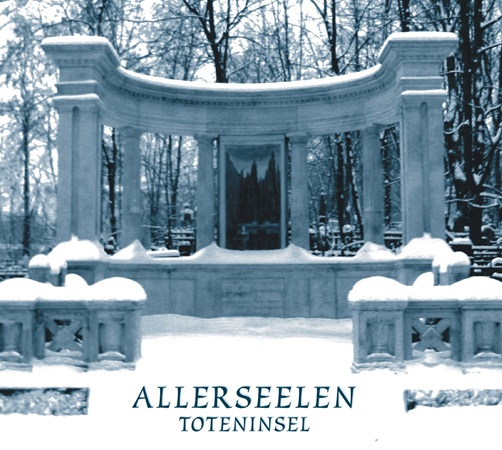
Allerseelen’s work has always come across as very conceptually layered. The newest album Toteninsel is no exception. In part, it is a reference to the painting of the same name by Swiss symbolist painter Arnold Böcklin (1827–1901), which is to be found in the albums cover photo. At the same time, many of the lyrics deal directly or tangentially with death, adding another layer to the album.
– Toteninsel refers of course to Böcklin’s famous painting, that he painted numerous times. His son also painted his own Toteninsel. I love the works of this painter and was also fascinated to find out that he also had constructed flying apparatus. He wrote about his experiences with his inventions and also in a book called Neben meiner Kunst (Besides My Art). Luckily he never had a real accident. So I combined these two concepts – the island of the dead and the Icarus myth. Although in the case of Böcklin the Daedalus myth would have more appropriate. But Ikarus is much more fascinating for many artists, his impatience, his fever, his ambition, his keen vision.
– Also the death of some beloved persons inspired the atmosphere and character of the release. So the whole concept of death was at the same time something very personal, physical, real in the process of recording the whole CD – but on the other hand it also remained something absolute, abstract, a fiction, a symbol that had and has a dystopian and utopian significance at the same time – depending on how much someone loves the lights and shadows of life.
– The theme Toteninsel also fits perfectly with the name of your magazine: If only the island of the dead is real, then what we call life would then be just a sea of dreams, myths, illusions surrounding the island of death. (Which, incidentally, comes very close to the intended significance of the name! -ed)
Complex as Allerseelen’s concepts are, and extending far beyond the realm of music to encompass poetry, philosophy and art on a broader scale, Gerhard nonetheless rejects the notion of Allerseelen representing a Gesamtkunstwerk of some kind:
– It is not really a Gesamtkunstwerk as basically I am concentrating on the music, the lyrics and the artwork of the releases. I did a couple of videos for Allerseelen but did not really spend a lot of time on this. Also on stage, videos are not very important for Allerseelen – we prefer that the audience looks at the musicians and not that much on events taking place on a screen. But in general I like the idea of music projects that are creating certain small parallel universes.
As with a lot of post-industrial and neofolk music, Allerseelen has faced its share of controversy. Gerhard admits to having sometimes courted it, but overall doesn’t see Allerseelen as ever having been particularly inflammatory:
– Nowadays, the world of Allerseelen is quite peaceful but there has been a period when I was fascinated by playing with the fire of certain topics related to the history of the twentieth century – and then I burnt my fingers from time to time. But nothing really dangerous ever happened. There were never real conflicts with enemies or also officials. Of course, concepts like Gotos=Kalanda, based on poems written in 1937, and Neuschwabenland, inspired by the utopia of a German colony in Antarctica created in the years of the second world war, have been controversial and stirred up some dust.
– But in fact most other concept releases by Allerseelen were not controversial or dangerous at all – or only contained small amounts of “toxic” ideas or allegations. I never believed that politics may really change something. I believe much more in the power of art – this is why I always have been an artist and never active in the world of politics. I always tried and still intend to keep Allerseelen in a sphere of apoliteia, in an outlaw position outside of political interests. If something may be a medicine against a toxic modern world, it will rather be art with its surrealism and symbolism, its metaphysics and also metapolitics – but definitely not the material world of economy and politics.
Is Allerseelen neofolk? Is it post-industrial? As alluded to in the intro, pigeonholing Allerseelen is an excercise in futility. Gerhard himself has in the past described Allerseelen as “Technosophische Tonkunst”, which is a good a definition as any – and better than some.
– In the spring of 2026, I used the description “technosophical troubadour” for my work when I performed on a small stage in Austria with the musician Andreas Adam playing a styrian dulcimer the song Medizin nach Mitternacht (Medicine after Midnight) by the Hungarian project Napsorvadás (who we interviewed earlier). This expression still makes sense for Allerseelen as a synthesis of technology and spirituality. With the use of synthesizers, Allerseelen always has been far away from the simple guitarplay and static drums of average neofolk groups. But Allerseelen is also far away from “brutalistic” power electronics and harsh industrial music that had as inspiration genocides, mass murderers, psychopathia sexualis etcetera. I always tried to stay away from this kind of apocalyptic culture.
– So the word technosophical may be a useful metaphor. Basically I always try to avoid being linked to a certain genre. Although the roots of Allerseelen are definitely the industrial music of pioneers like SPK and Throbbing Gristle – the first records that I bought as teenager were by these two projects. I still like the word technosophical although I do not think that I invented this word. It makes me think also of Theosophy – a term that was invented in the nineteenth century. The term technosophical fits fine with Allerseelen in the 21st century as our music always combines technology, philosophy and poetry.
In the end, Gerhard settles for the broad term of post-industrial. It’s a descriptor that says very little about the music, but plenty of the genealogy and lineage of a project. Perhaps that is the best way to categorize Allerseelen, if one must categorize: not by how it sounds – which anyhow has changed a lot during the years – but in what (sub)cultural context and current it exists:
– Maybe “post-industrial” would fit best, like a field of force between Coil, Deutsch Amerikanische Freundschaft (DAF), Einstürzende Neubauten, Nine Inch Nails and Psychic TV. But in general I am an enemy of this labelling, I liked your words on this topic in your review on the Toteninsel CD. It is always difficult to describe music. I have this problem when I am listening to songs by other musicians – but this problem is even worse when I am asked or “have” to describe my own works. It is difficult to talk about music, to describe it. One could imagine that this becomes easier for a musician that has being asked the same question again and again. Yet – this has not become easier for me in all these years. Also because there have been some changes in the oeuvre of Allerseelen – elements that changed, elements that remained the same.
And sad news for fans of neofolk, if you’re inclined to take personally the opinions of others. Gerhard is not too fond of the genre as a whole:
– Actually I never listen to neofolk. This genre is a bit too simple for my taste, and there are too many projects that are feel glad and satisfied by just imitating each other. This created a certain biotope or monoculture – and I am glad to be an outlaw, a Steppenwolf in this genre like in all other genres too. For neofolk there have always too many electronic elements in Allerseelen – but for followers of power electronics or other extreme industrial music, Allerseelen is far too melancholic, melodic, poetic, even too much pop.
Visit Allerseelen on Bandcamp or Facebook, or Gerhard’s Instagram
Photos via Allerseelen


One thought on “A post-industrial Steppenwolf in a colder age: talking with Gerhard Hallstatt of Allerseelen”