

Tapio Kotkavuori’s 2004 book Vasemman Käden Polku (The Left Hand Path in English) was a groundbreaking book in its time. It was one of the first, if not THE first serious exposition of left-hand path occultism and magick written in Finland. Earlier books, such as Pekka Siitoin’s legendary Musta Magia Osa I and Musta Magia Osa II, had typically been of a more eccentric nature. To put it mildly. Other authors, such as the grand old man of Finnish esotericism, Pekka Ervast, had written from a more “right-hand path” perspective.
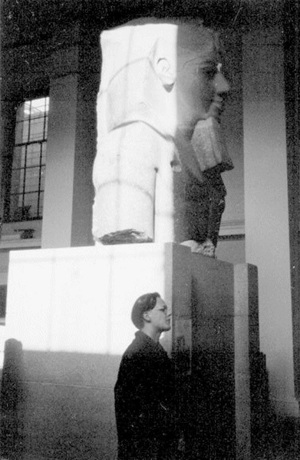
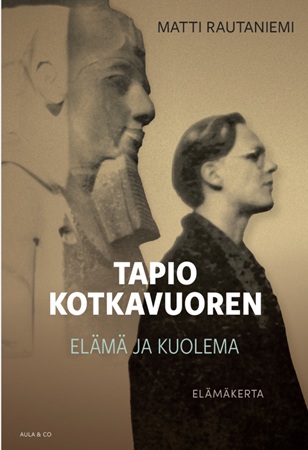
Earlier this year, Matti Rautaniemi’s brilliant biography Tapio Kotkavuoren Elämä Ja Kuolema (reviewed here), detailing Kotkavuori’s time in the Temple Of Set, was published to considerable acclaim and interest even in mainstream media. Without going deep into the book – read the review if you want to find out more – Rautaniemi presents a compelling and interesting depiction of Kotkavuori’s path into and, ultimately, out of the left-hand path. It’s a story where the integration of esoteric insight and daily life is a key element. Initiation is not only at the core of the book, but Kotkavuori’s very essence.
Already whilst reading Rautaniemi’s book, it became obvious that it was time to revisit Vasemman Käden Polku. I had last read it in 2025, soon after Finnish Abraxas Publishing released a 20th anniversary edition. Then, Kotkavuori’s often rather down-to-earth and rational though transcendent approach felt a little off-putting. Someone once said occult literature is essentially self-help with fancier symbolism, and it felt like Kotkavuori stripped even the symbolism away. No summoning of demons or lesser spirits here, no ornate sigils, no bestial names of evocation. However: Rautaniemi compellingly shows how Kotkavuori’s less theatric approach can be seen as deeply profound; in many ways moreso than more dramatic and pompous approaches.
(N.B.: I will predominantly refer to “Kotkavuori’s philosophy” etc. instead of the Temple Of Set’s, as this is a commentary on the book, not the teachings of the Temple Of Set.)
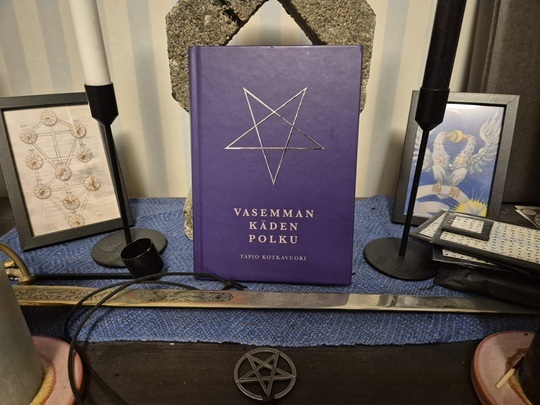
As already the name implies, Vasemman Käden Polku is written from a rather conventional viewpoint in modern esotericism, where the occult path is seen as divided into two distinct approaches. Obviously, the viewpoint of the author is that of the left-hand path, sometimes also called the “sinister path”, the “lunar path” or the “downward path”; often, especially in more popularized accounts, it is equated with Satanism and devil worship, and seen as deeply adversarial to both the right-hand path and authorities both profane and sacral. However, in Kotkavuori’s interpretation, there is little of sinister and minimally anything demonic involved, especially not in a sense of idolizing evil and immorality. What few sinister elements there are, such as an insistence on calling his magick “black magick”, which evokes very specific sinister associations, can sometimes feel a bit hard to reconcile with Kotkavuori’s actual ideas. Contrary to stereotypical readings of “sinister occultism”, Kotkavuori emphasizes ethics and the importance of an ethical and moral approach; his take on the left-hand path can’t be called adversarial in any conventional or banal sense.
Above all, Kotkavuori’s division of the left-hand and the right-hand path has to do with emphasis on the esoteric and exoteric aspects. The right-hand path is characterised as one relying on external authorities and external dogma, and aligning oneself with these. Conversely, the left-hand path is a path that rejects the very same authorities and dogma, emphasizing discovering one’s own individual path. Kotkavuori himself mentions antinomianism as an aspect of the left-hand path, but it is important to note, as Kotkavuori emphasizes on numerous occasions, that this does not constitute a rejection or reversal of ethics, or opposition to established order just for the sake of it. He rejects dependence on spiritual authority, but not the importance of respect and reverence towards all life.
At the very core of Kotkavuori’s left-hand path philosophy is the Setian concept of Xeper, the process of Becoming. Whilst Xeper is a markedly Setian concept, overall a general concept of Becoming has a central role in many esoteric traditions. Distinguishing it from other traditions, Kotkavuori’s interpretation of Becoming is deeply individualist: MY will be done instead of THY will be done. Ultimately, however, the concept still shares common ground with less individualistically oriented traditions; realizing one’s fullest potential and actualizing everything one can be. Different traditions have expressed this attainment in different ways: realizing your Will, becoming yourself, remembering yourself, and so on.
Kotkavuori’s view of the relationship between the separate Self and the objective universe is strongly informed by the hermetic concepts of the macrocosm and the microcosm. However, instead of the two rigidly reflecting each other – as above, so below – or the microcosm reflecting the macrocosm, in Kotkavuori’s philosophy, the Self is separate, and the purpose is to nurture, strengthen and engender the subjective universe. This is done by strengthening the so-called magical link between the two, which allows the initiate to better realize their separate self and True Will in the shared universe, thus shaping the objective universe more in their image.
Though the view of the role of the Self and the dynamic between the subjective and the objective universe differs from that of many other esoteric traditions, there are parallels as well. The dynamism of Being and Becoming were key to Julius Evola as well, for example: he considered the purpose of the initiatic path to be integration with the transcendent, in which false individualism was eradicated. This was achieved through an ennobling of spirit, which in many ways is less different from Kotkavuori’s transcendent self-improvement than would appear on a surface level.
Whilst the strong emphasis on individuality and the Self, as opposed to contact or connection to some external, transcendent power separates Kotkavuori’s philosophy from the likes of Aleister Crowley, the concept of individual striving and attainment builds upon a longer tradition. In Evola’s Introduction To Magic, consisting of essays of the Ur Group (an Italian esoteric collective active in the interwar period of the 20th century), the initiatic path is defined with focus on action, practice and identification instead of passive, theoretical contemplation. Where the priest, according to Evola, mediates and contemplates divine wisdom, the magician seeks actively, through individual action, to identify with and attain to that source of wisdom. The priest seeks to understand, the magician to become. In many traditions, even if there have been more altruistic ulterior motives, such as serving one’s community or the entirety of mankind, the magician’s path of initiation is deeply individual, characterised by personal struggle and attainment.
In this context, the significant difference between Kotkavuori’s interpretation and more traditional western interpretations of magick and initiation is that Kotkavuori eschews established systems in favour of creating one’s own magical cosmology, so to speak. The Ur Group leaned on the same western tradition that The Hermetic Order Of The Golden Dawn and Aleister Crowley’s Thelema did: kabbala, the Enochian system, tarot, and so on. In contrast, Kotkavuori calls for the creation of a personal system of meanings and, insofar as ritual work is involved, the creation of one’s own rituals and workings instead of reliance on established formulae. Established systems and symbols serve a purpose in Kotkavuori’s thought primarily if they reverberate personally, as opposed to having some intrinsic efficacy.
Where many western magical traditions have seen union or communion with some external, macrocosmic force as their goal – for example integration with the Absolute, some divine deity or a higher plane of being – Kotkavuori advocates the opposite: an exaltation and ever clearer definition of the separated, individuated Self. The aim is not to merge into universal Oneness, but to foster a powerful, subjective universe. One must, however, be careful to separate this from any kind of self-indulgent, egotist solipsism. Even if the Self is at the centre of one’s personal universe, it is not the only thing existing in the objective universe cohabited by other beings; and as such, according to Kotkavuori, we have a moral obligation to treat others – other Selves – with both respect and kindness.
Kotkavuori’s definition of magick builds upon late 19th century/early 20th century definitions, Aleister Crowley in particular. Both Will and Intention are key elements, and magick is seen as the art or science of affecting change with Intention. Kotkavuori defines magick as an act of the conscious Self in the universe, integrating the western tradition with his emphasis on the separate Self. He also states that we are what we do consciously e.g., that one cannot fully separate action from essence. Thus, magick encompasses more than a mere act of the Self – in magick, the Self reveals itself. Magick, therefore, becomes an aspect of the process of Becoming and initiation.
Initiation rises to become the core concept. For Kotkavuori, initiation is something deeply personal, esoteric in the truest meaning of the word: an internal, personal process of attainment and gnosis. External recognition such as grades in esoteric Orders at best only reflect the personal process, and true initiation cannot be conferred by others, it must emerge from within. Rautaniemi’s book emphasizes that initiation is also a continuous, integrated process. There is no separation between daily life and some kind of “esoteric life”: occult insight must needs inform daily life, and it is in daily life that occult learning transforms into the understanding and gnosis that initiation builds upon. Kotkavuori’s take on initiation is deeply holistic, and penetrates every facet of life. It’s not something that happens in a ritual space during some ceremony.
Expanding from this, magick takes on what might at first sight seem like a plainer, more mundane nature, but actually has profound depth. The ceremonial pomp of the Black Mass or the ritual formulae of the Middle Pillar and the Lesser Banishing Ritual Of The Pentagram can, following Kotkavuori’s thought, be seen as more extraneous to the initiate than those small changes in daily life and routines that aid in better channelling the Highest Self in every action and moment. The latter are acts of integrating transcendent gnosis into every moment, through which their significance is enhanced.
But, as Rautaniemi points out in his biography, Kotkavuori engaged in ritual magick as well; so one should not pit Kotkavuori’s more subtle understanding of magick against formalized ritual magick as some kind of antithesis. Both have their function – as do initiatory organizations, considering Kotkavuori belonged to one for a considerable amount of time.
So, what at first sight might seem like a banalisation of occultism is actually the opposite. What Kotkavuori advocates, and Rautaniemi illumines in writing about Kotkavuori’s life, is a de-banalisation of daily life. Every moment, every choice, every action can be seen as one where the individual actualizes their initiation, or furthers it. If our every act is informed by our true, separate Self, then every act is, in fact, magick. This holds true even from less Setian viewpoints: we may speak of Will, daimonic inspiration, communion with our Holy Guardian Angel or some such, there’s definitely an argument to be made for channelling it in everyday life, not just as an esoteric pastime.
Of course, even for the initiate, it is far too easy to relapse into a state of automation, of carrying on without conscious application of the Self or whatever higher principle one believes in. As Kotkavuori writes, it is a tendency in us humans to do so. So we must be sure to not only Become, but to continuously Remember Ourselves.
In this context, the role of more formal ritual magick can be seen as an enforcement or empowerment of the individual; a symbolic process or exercise that invigorates and awakens, and re-enforces the connection to a magical current and to intentional action. The most significant magick is that quiet magick of acting consciously, intentionally and with an understanding of how to achieve the intended results. Compared to this, ritual and ceremony become lesser forms of magick, exercises replete with symbolism that aim to prime the mind.
This is the form most of the rituals take in Vasemman Käden Polku. They are primarily exercises to aid and assist in Becoming, and being more attuned to one’s true Self. Many of them are akin to checkpoints: the initiate sets goals for themselves, and the rituals help keeping these in mind and striving towards them. Kotkavuori’s variation of the ancient Germanic sumble ritual, which he calls Karhunmalja (toast of the bear) is a good example. Here the initiate sets goals for themselves, consolidating them with ritual toasts, and returns to them periodically, reviewing their progress through ritual work.
But: invocations of spirits or reliance on external forces have little place in Kotkavuori’s definition of magick. Advocates of what Stephen Skinner calls the spirit-model of magick e.g., who consider magick to truly involve non-human, spiritual entities, may find little of appeal in the rituals described in the book, which invoke only the Self – and the Prince of Darkness so central to Setian philosophy.
Within a few years of publishing Vasemman Käden Polku, Tapio Kotkavuori’s path diverged from the Temple Of Set. Even though the division of the initiatic path to left-hand and right-hand paths is foundational to the book, there are indications in Vasemman Käden Polku of a more unified approach. Kotkavuori sees overlap in the two paths, and rather than polar opposites, it would perhaps be more correct to say Kotkavuori sees them as layered strata. Where to him the right-hand path offers categorical, dogmatic answers, the left-hand path builds upon these, sometimes through opposition and rejection, to offer a subjective, more individual approach. Kotkavuori acknowledges that it is next to impossible to exist without elements of the right-hand path in one’s life: school, laws, societal norms and so on. As such, in Kotkavuori’s approach, those who aren’t satisfied by the exoteric, dogmatic answers of the right-hand path can “rise” to the more individual left-hand path.
Ultimately, it is most conducive to read the book without subscribing to categorical, mutually exclusive divisions of two paths of initiation. Similarly, it is both quite easy and best to look past the few “sinister” trappings of the book, such as allusions to black magick, the Black Flame and the Prince of Darkness, unless one approaches esotericism from an exclusively Setian, or generally “sinister” perspective. There is nothing inherently sinister or “black” in the sense of evil or opposition to good in Vasemman Käden Polku; rather, what Kotkavuori offers is an interpretation of initiation and esotericism that combines rationality with a transcendental, magical outlook. To wax poetical, what darkness is found in Kotkavuori’s philosophy is the state existing before light, a liminal state from where illumination may emerge.
This understood, what Kotkavuori describes is a holistic path of individual initiation. The Path of Becoming is one where every act should reflect, further and bolster initiation and attainment. For one already on the initiatic path, this can be seen as an even more central takeaway than the question of the ultimate purpose of initiation; whether it’s about integration into the Absolute or the strengthening of a Self separate from the objective universe. Regardless of how one sees it, Kotkavuori’s pivotal message remains relevant: make your life into a monument of your initiation; understand, that initiation happens in every moment and in everything you do. When you realize this, magick is in every act you do.
BIBLIOGRAPHY
Crowley, Aleister (Skinner, Stephen ed.): Aleister Crowley’s Four Books Of Magick – Liber ABA (Watkins 2021)
Evola, Julius (ed.): Introduction To Magic Volume I (Inner Traditions 2021)
Kotkavuori, Tapio: Vasemman Käden Polku, 20-vuotisjuhlapainos (Abraxas Publishing 2024)
Rautaniemi, Matti: Tapio Kotkavuoren Elämä Ja Kuolema (Aula & Co. 2026)
Regardie, Israel: The Golden Dawn (Llewellyn 2003)


2 thoughts on “Xeper!: Reflections on Tapio Kotkavuori’s Left-Hand Path”