
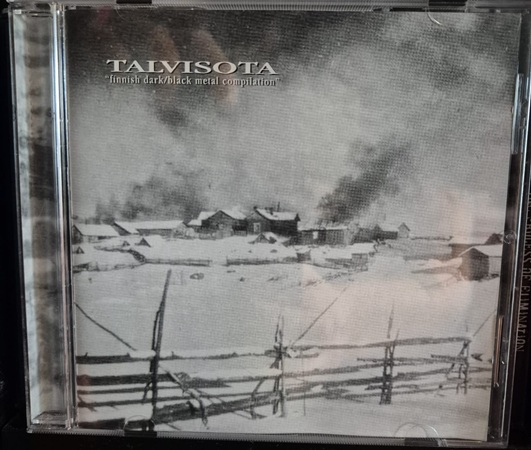
If you lived in Finland and were getting into underground extreme metal, it is quite likely you encountered three compilation CD’s early on: BlackMetalliliitto, True Kings Of Norway and this, Talvisota. All three were usually found at reduced prices, were easy to find, and offered a well-curated introductory selection of tracks.
We will eventually cover the two firstmentioned CD’s, but today we’ll focus on the one most significant to ODIR: Finnish Woodcut Records’ Talvisota, a Finnish dark/black metal compilation, as its subtitle proclaims.
In hindsight, Talvisota presents a surprisingly good moment-in-time type of overview of Finnish black metal at the turn of the millennium. Certainly, a single compilation cannot be comprehensive or exhaustive, but throughout its 17 tracks and roughly 74 minutes, it presents a balanced overview of what was going on in the not-too-obscure strata of the underground, with some deep cuts.
The “deep cut” department consists of acts such as Flauros and Kyprian’s Circle, who’d rather quickly fade and not leave much in terms of recorded output as legacy. (We’ll return to Kyprian’s Circle in a future installment of this series). However, most of the featured artists had or would attain a slightly higher profile at least domestically: Finntroll and Moonsorrow would go on to become staples of pagan/folk metal, Alghazanth, Mustan Kuun Lapset and …And Oceans would carve their own nichés in the coming years, Behexen rise to the forefront of Finnish black metal, and so on. None of these bands had more than one album out, some not even that, so perhaps one can laud whoever compiled Talvisota for having a good nose for potential.
In 2000, Finnish black metal wasn’t the powerhouse it would later become, but it was also far from a marginal scene. Acts such as Beherit, Impaled Nazarene and Barathrum had all released seminal material that expanded the horizons of the genre. For the most part, Talvisota eschews these few established names in favour of newer acts. Barathrum, Thy Serpent and Horna represent older, more established acts – although it can be argued that Horna would carve their lasting legacy in the years after Talvisota.
Acting as something of a gateway drug, Talvisota helped usher me and countless others deeper into the underground, away from more mainstream black metal such as Dimmu Borgir and Cradle Of Filth, or established names like Emperor and Satyricon. It gave a sample of the treasures just waiting beneath the surface – often from labels that had decent distribution (including, obviously, many of Woodcut’s own releases), so one could actually find the CD’s without knowledge of obscure distros. In those days, it wasn’t as easy as googling a name and finding dozens of webshops stocking them. Learning of distros meant knowing people, reading ‘zines, getting flyers with orders and so on.
It’s true that there were deeper layers of the underground Talvisota didn’t cover. Artists such as Clandestine Blaze, Azaghal and Warloghe operated on entirely different levels of obscurity than most of the acts to be found on Talvisota. But nonetheless, Talvisota opened the door an inch. In a time when in many people’s minds black metal was just about synonymous with Norway, Talvisota proved that there was a diverse, active and sprawling homegrown scene in Finland as well – and one with quality. Virtually all of the 17 cuts on Talvisota bear listening to even a quarter of a century later, which speaks volumes of the talent and potential in Finland then.
Talvisota would spawn a successor two years later called Jatkosota – the names translate to “winter war” and “continuation war”, the two wars Finland fought against the Soviet Union during the Second World War – but I never got around to buying it. By that time, Talvisota had served its purpose and I was no longer in need of another portal drug into the black metal underground.
In hindsight, Talvisota came along at the perfect time for me. I already had albums by some of the artists on Talvisota (such as Alghazanth and Barathrum), others were familiar in name (such as Horna), but most were entirely new to me. Had it come along a couple of years sooner, Talvisota might have been too obscure to capture my attention; later, and I’d probably have passed the point where a compilation like this would have been of much use. But coming as it did when it did, Talvisota served as a guide into what was going on in Finland.
As such, there’s no point in denying there’s more than a small bit of nostalgia in revisiting this CD. Talvisota helped define my musical path for the next couple of years. Despite that, I feel confident in saying that now, 26 years later, Talvisota serves as a fine document of the state of the Finnish underground in 2000. It’s not exhaustive, it doesn’t reach into the deepest depths, but even so, the 17 bands featured here offer an informative view into the Finnish black metal underground of its time, in a time before acts such as Satanic Warmaster ushered it towards a new era of global acclaim.
In From The Vaults we take a dive into the record collection at Only Death Is Real HQ and write about about items of iconic stature or personal significance; rarities and oddities from the archives; obscure gems that deserve more attention; classics of yore deserving of a moment in the limelight; and so on.


One thought on “From the Vaults #26: Talvisota”