
The journey that post-industrial folk/neofolk group Crooked Mouth has undertaken since their debut release in 2013 is fascinating to say the least. What started out as an acoustic solo side project to a black metal band has evolved to a full band that combines traditional music with experimental (neo)folk, but the journey has also been much more tangible: in 2022, the founding member and primus motor of the band, Ian Campbell, relocated to Lithuania. The two albums released since then, 2023’s Between The Fool & The Magician and especially this year’s Cosmic Folklore, has seen the band immerse itself in the European, western esoteric tradition and Eastern European folklore. In anticipation of the band’s first ever performances in Finland, we had a chat with Ian about the move to Europe and how it affected the band, Baltic folklore, the role of tradition in modern society and much more…
On Between The Fool & The Magician, Crooked Mouth explored the imagery of the tarot. One interpretation of the Major Arcana of the tarot is that it reflects the journey of the Fool, both as a corporeal journey and as a spiritual journey towards attainment. The Fool’s journey is fraught with risk but offers great rewards, and is undertaken boldly but perhaps also out of foolhardiness. Reflecting upon Crooked Mouth’s journey, especially the relocation from western Canada to Lithuania in Eastern Europe, it is not too hard to see these elements in Crooked Mouth’s and Ian’s life. So is he the Fool of the tarot?
– In the lyrics of the title track of that album, I ask the question; “Am I the Fool or the Magician?” This is a question that I still feel I cannot answer. But, I can certainly say I have many Foolish elements to my personality. The relocation was indeed a leap of faith, and part of why I did it was to test a certain hypothesis about the universe and the very idea that leaps of faith will be supported by some kind of unknown force. I found this to be confirmed.
The move to Europe has had a profound transformative impact on Crooked Mouth. Not only did it immerse the project in an entirely different cultural context, it also saw the band grow from a solo side-project to a proper band, and the focal point of Ian’s musical expression. In a way, one can indeed talk of a “Canadian Crooked Mouth” and a “European Crooked Mouth”:
– It’s two different lives completely. “European Crooked Mouth” operates like a real band, more seriously, with goals, with an audience, with a lot of energy. “Canadian Crooked Mouth” began as a side project to my black metal music, and my expectations toward opportunities that it would have were always very low, mostly because of geographic problems and that this kind of music is completely obscure and not appreciated there.
– However I would say there is a certain spirit of “localism” which has remained. My records are always very influenced by place. The debut was inspired by my isolation in Northern British Columbia. Decay was a record about family history and atmosphere of the west coast of that province. Coastal was specifically about my birthplace, Vancouver Island. Between The Fool & The Magician was one foot in that same place and one foot in Vilnius, Lithuania, and now Cosmic Folklore is firmly in Lithuania, looking to other parts of Europe that we’ve travelled to.
The relocation was not only a move halfway across the globe, but a move to a very different spiritual clime. The old Lithuanian folk traditions survive much stronger than in many other European countries, and the neo-pagan resurgence has gained considerable momentum in the years since the collapse of the Soviet Union. Naturally, this has had an impact on both Ian and Crooked Mouth:
– Baltic spirituality has indeed had a large impact on me, less from an intellectual level, and more from one of experience. Also, I would say “traditional” spirituality is not such a thing here as people outside might be led to think. The neopagan movements are reconstructionist, and they include all kinds of assumptions and creative interpretations that are not supported by archaeological reality. However, I don’t find this important, that’s not a dig against them.
– What I’ve learned to try to focus on are the current, modern manifestations of spiritual archetypes and truths. The question is, what is the current experience of these “other worlds”, because I see the world through a monist lens. There is one world and universe, there is a truth expressing itself in infinite and contradictory ways. The ancient Balts experienced it one way, the modern Balts, another, with reference to that past, and the lone traveller from a faraway land experiences it still a third way. But true spirituality is not a set of clothes to be put on and worn. “I’m a Catholic, I’m Romuva, I’m an Anthroposophist”. This is ultimately all nonsense. Anyone who seriously participates in one tradition will realize that every one of them expresses glimmers of the same truth.
– So, as solitary movements, identity groups, or tribes, I have absolutely no interest in them, they may as well be sports teams. It’s of course a classic symptom of the Kali Yuga that all structures are corrupt. But, at the same time, as entities that hold the stored experiential knowledge of humanity through many different ages, civilizations, and layers of consciousness, they are precious, sacred, and invaluable.
As a foreigner who has moved to Lithuania, how “deep” does Ian feel he can get into Lithuanian tradition and spirituality, I ask: is there a point beyond which he thinks he cannot, or might not want to go?
– The topic about being an outsider here is a big one. I certainly am an outsider. I will never be considered a Lithuanian by 99% of people here, even if one day I got full citizenship and learned the language fluently – this is an extremely different attitude when comparing who we accept as “Canadian” where I was born. This has taken some getting used to, but it’s completely understandable. There is an assumption in your question that I would have to, or want to, be completely accepted as a native to get something out of the spiritual life of the Balts, but actually this is not true. (An unintentional assumption, I add! -ed.)
– Lithuanians who are part of this spiritual world, or “scene” or whatever, are usually pretty open to foreigners’ interest in their ways. Most of them understand that people like me from the west might be seeking something that was lost to us, but still exists in some form here, and they are open to sharing that with us. Even very nationalistic types who want to claim or own these traditions in the name of the modern Lithuanian state and defend them in its name are not hostile to people like me. Usually they are proud to “show off” their culture, so to speak.
– An important thing to understand is that here, all culture – not just spiritual things – is participatory, meaning, you show up, and you do the thing. Whether that be the ritual, the dance, the cultural exhibition, or cooking shashlik at the village. There is not much talking about how or why things should be done, and no one will ever explain to you what is going to happen, or what you should do, and you’re VERY lucky if someone will translate something for you. You watch, you mimic, and everyone is happy. It works for Lithuanians because they grow up in this environment, and that’s one way they learn. They watch, they do, and then they know. The culture is homogeneous, until very recently, and the idea that people like me might be there and hoping for some guidance isn’t really considered, unless I speak up, and I’m a polite Canadian boy who hates doing that!
– I experience this phenomenon as a double-edged sword. I like getting a break from all the hyper-intellectualizing that happens in Canada, but sometimes I’d also like to know ahead of time what the hell is going on…
Ian points out, that at its core, Lithuanian spirituality runs much deeper than modern notions of a cultural identity tied to a certain place defined by boundaries on a map – an observation that can be expanded to most traditional forms of spirituality:
– A lot of Baltic cosmology is completely archetypal, universal, and not bound by time or space. This is what should be expected from music and folklore that comes from a time in humanity’s past before conceptions of “nationhood”, “state”, or ethnic ownership. The most ancient Lithuanian music is not about “being Lithuanian”, it’s about experiencing the cosmos as one being among many, visible and invisible. This is how I think those ancestors experienced life. They were free from all the constructions of the intellect that cause us so much strife today.
– I will try to give an example from the music I know. Lithuania and Latvia have collections of songs (Dainos), thousands of them, collected from villages by folklorists in the 19th century, as was the trend everywhere at that time. Many of these songs show the entire pagan worldview very simply if you know how to decode the symbols. The family is always the main focus, with a husband, wife, son, daughter, grandparents. There is usually a tree. Birds and bees are also very important, along with the sun and moon.
– The songs with the son as the main character usually have quite a different quality to ones where the daughter is central. Usually, the son is “going out into the word”, and the daughter is preparing for marriage. This “cosmic family”, as one bandmate has called it, could be the Gods, or they could also be your own family, or maybe they are both and the Gods and your family, with all their conflicts and bickering, are really the same thing. Indo-European cultures always have a world-tree, and the world tree has residents, like bees, birds, a serpent at the bottom, for example.
– Most of these symbols are in our song Kelias Kelelis. (The lyrics to which can be found on Crooked Mouth’s Bandcamp page; the video below begins with a live rendition of this song. -ed)
Ian has previously mentioned that he felt a kind of magic when he first visited Lithuania, some years before he decided to relocate there. I ask him, does he think this feeling is somehow tied to the survival and continued presence of the old ways and traditions in Lithuania?
– Yes, I think these things are connected, but this fact is also influenced as much by recent history. There’s so many layers to the history here. The ancient layer is one of them, with many others overlaid on top.
– The countryside remained relatively undeveloped during the USSR’s occupation. As a result there is a lot of unspoiled nature here. The development of industry and urbanization that led westerners to abandon their more traditional lifestyles hundreds of years earlier was not so much a factor here. Of course, cultural memory was still massively effected by this occupation period, but instead of leaving their traditions and language, the people who thought they were important clung to them harder, and nowadays they embrace them happily, and without self-consciousness or guilt. However, village and rural culture is dead/dying in front of our eyes here currently. Instead of being a relic of hundreds of years ago, I can see this dying process with my own eyes. By no means is the whole country some kind of bucolic paradise.
– Another interesting aspect to me is that people here are more prone to superstition and general magical thinking. It is not laughed at or put down, but quietly accepted as a regular part of life… maybe Catholicism leaves room for this where Protestantism does not?
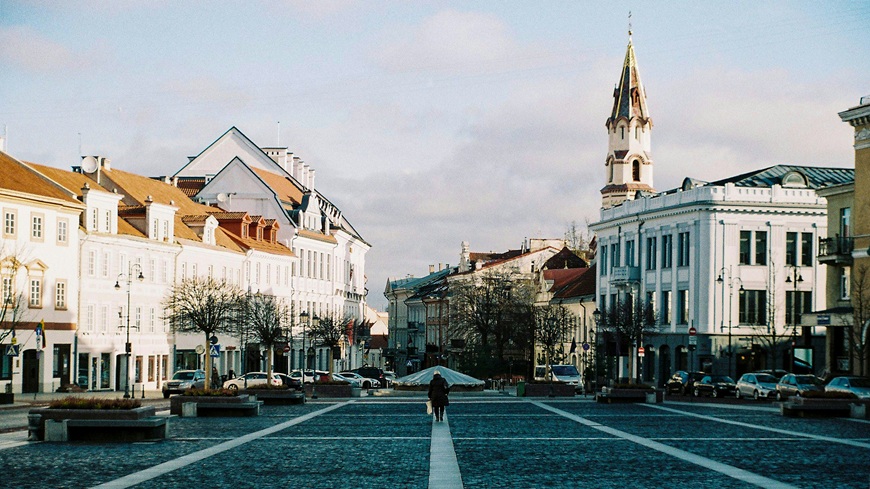
– Regardless of all of that, when I walk the streets here, I can feel the footsteps of 700 years of people in this city, and I can visit the older hillforts and feel the stories of many thousands of years earlier. In the forests I feel the presence of the beings from fairy tales and folklore. Perhaps they are created by the psychic energy of 3000 years of people walking similar paths, or perhaps they were just there the whole time. Either way, despite the great beauty of the region I come from in Canada, to me, those woods feel empty, and those city streets are bare and lonely. On the streets of Vilnius old town, you at least have the ghosts to keep you company.
Expanding the above discussion a universal level, I ask what Ian thinks is the role of ancient/pagan tradition in the modern age? To what extent do paganism and traditional folklore, for example, carry a living message in our modern age, and to what extent is it a dead echo from a broken line of tradition?
– It’s a difficult question. I think my relationship to it has changed a lot over the years. Today, I see it as a window back to a previous type of consciousness and outlook towards the world. Whilst looking through that window, I can admit that what I see there is probably something distorted, the glass is smudged, and something else is blocking my view, and maybe I’m even hallucinating part of it. That is all to say, the picture we have of the past isn’t clear at all.
– But regardless, I can see something beautiful through that window, despite all the problems of perception. And what I can see is something I’d like to use to inform my life. At the same time, I can admit that I don’t live in that picture I see through the window. I need to turn around and deal with the mess that is the inside of my house!
– This might disappoint some people to read, but to be honest, these days I take more of practical value from esoteric Christian teachers than from modern paganism. But the interesting thing is, some of these teachers – I’m thinking principally of Rudolf Steiner, Valentin Tomberg, Daskalos, maybe a few others of the anthroposophic movement – present a picture of the world that is, from a certain point of view, very pagan. In the way they expressed the universal order, nature spirits exist on a certain level, angels and archangels on higher levels – these could be considered Gods – the spirits of the dead interact with us on Earth and reincarnation and karma are accepted as fact. Christ enters the picture as a balancing force that exists within all of this structure, and the emphasis is usually placed on the spirit of Christ, not the historical man Jesus. Very, very different kinds of ideas than you would ever find in a church.
– I mention this because what’s interesting to me now is trying to find some kind of combination between these two. I reject nothing offhand. I would prefer that conflicts be reconciled, not prolonged.
As a personal addendum, your editor of doubtful humbleness wishes to add the following: Though the above might seem odd or even irreconcilable to some, it is very much in line with the western esoteric tradition, which has always combined Christian and pre-Christian concepts in its search for transcendent wisdom. Most occultism is not, as it were, markedly anti-Christian.
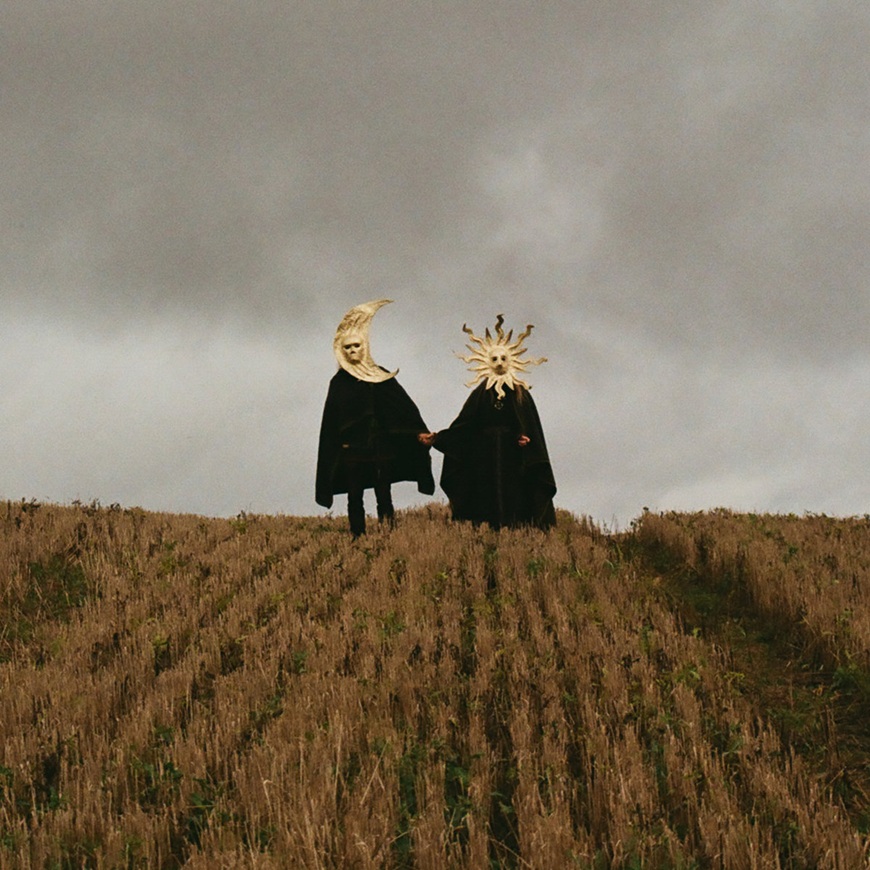
My interpretation of the title of Crooked Mouth’s most recent album, Cosmic Folklore, was that it explores European traditions to find a deeper, universal level. Ian corrects me:
– Actually the concept was particularly European. Cosmic Folklore refers to the folklore of the sun, moon, planets, and stars, of course this exists in all cultures, but I started from the Baltic, which is where I really became aware of it, and looked outward to surrounding cultures. At the same time these ideas were forming, my girlfriend and I were beginning to take astrology quite seriously, which added another layer.
– A lot of the songs on the album are interpretations of traditionals. At the end of the recording process I decided to include some of my own original works as well. At first, the cosmic folklore theme was quite loose. I didn’t feel that everything on the album completely related to it, but as I started to sequence the songs, I discovered there was indeed a narrative that was playing out over the length of the album.
– There is an image expressed by some of the teachers I mentioned above, and also older sources, of the journey of the soul as it incarnates to be born, and when it dies and leaves the body. In both of these moments, the soul travels through “spheres” of different planets on its way to and from the physical world. In Lithuanian and Finnish, and maybe other languages I’m unaware of, The Milky Way is called “The Path of the Birds”. These birds carry the person’s soul out to the stars and back again.
– My interpretation is that Cosmic Folklore could be listened to in two different ways. The first is; a young soul incarnates, ready to face the battle of life, as the lyrics of Kelias Kelelis describe. He meets others, his karmic family, he journeys through life and love, eventually to die as described in Pierre de Grenoble. The second way is reversed. Kelias Kelelis could also be interpreted as “beginning at the end”; the warrior dying near the side of the road, and the rest of the journey that follows describes his sojourn through the spiritual world in the stars.
– I did not have these images in mind when I created this music, so I cannot tell anyone it is the “correct” interpretation. In this case, I created first, and the message came to me later.
Like many artists within the neofolk/post-industrial scene, Crooked Mouth combines traditional spirituality and instrumentation with modern elements. I ask Ian in what ways this amalgamation of new and old, traditional and modern in sound expresses the deeper essence of Crooked Mouth – is it a seamless union, or something that causes creative friction?
– It’s seamless, yes, it has to be. I create music in a very intuitive way which needs to be harmonious and effortless. If I have that feeling, I know I’ve got something worthwhile. It doesn’t cause friction because one of the main themes of my life seems to be the fact that what seems like “friction” between those things doesn’t actually exist at all.
– I love to smash together seemingly opposing elements, for example having a nicely strummed acoustic guitar and beautiful vocal harmonies with blasts of noise created by pedals and a drum machine fed through a distorted amp (I’m thinking of the end of our song When the Sun Married the Moon).
– There’s no contradictions there for me, and it mostly happens automatically, without thinking. Beauty and dissonance exist equally, so why not play with them in combination? I think the same goes with the thematic aspect and lyrics. Thinking back, I suppose this has developed throughout my musical career, and I’ve honed my senses about it as I’ve gotten older.
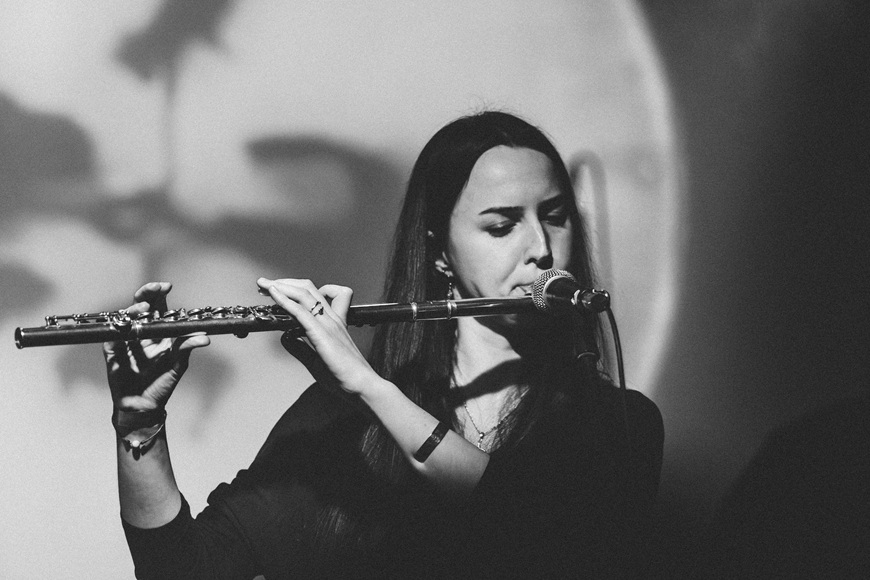
As has been discussed above, the communal element is central to both Baltic spirituality and Baltic customs in general. In previous interviews, Ian has also spoken of the significance of community for Crooked Mouth’s current incarnation, not only in the band and among its collaborators, but also with the audience. Neofolk, on the other hand, is often seen as the territory of lone wolves – as the classic Death In June line goes: “It is the plague of our age that we fight in isolation.”
– This is one of the reasons I’m not very satisfied being so associated with the neofolk genre. There are a lot of dead and useless cliches. That trope might have been apt in the 1980s, but anyone following that kind of life path now I think is just wallowing in a kind of extended adolescence. The cliche itself presents a certain truth, sure, but it poses a question and a challenge: how to respond to that truth?
And in truth, Douglas P. was probably making an observation, not laying down dogma, as is proven by the definitely communal nature of the old apocalyptic folk groups. At any rate, Crooked Mouth has always had a strong collaborative element:
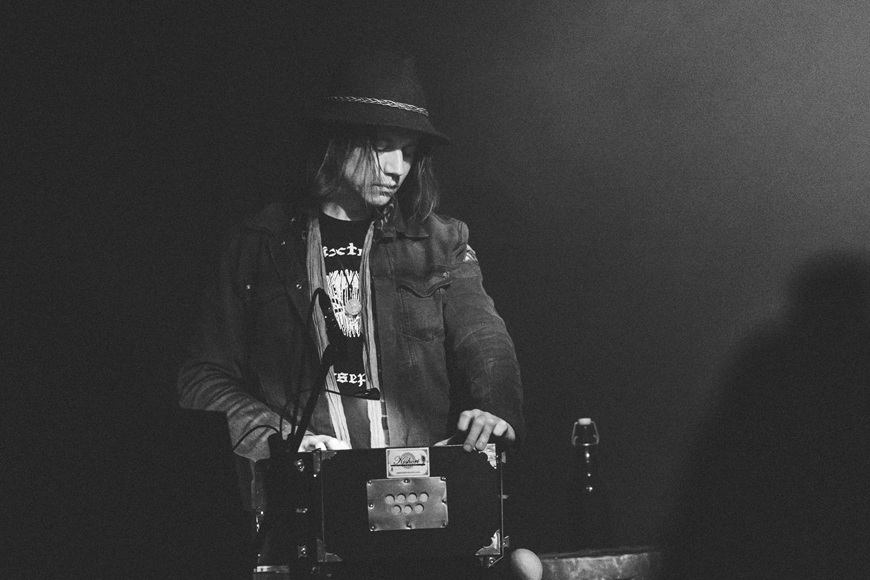
– This community aspect has become a very important and defining aspect of the band. I would say it began back in Canada, when I first wanted to perform with more musicians, I asked some friends from Night Profound to join me, once that started, there were suddenly a cast of characters who would join me in a kind of rotating lineup – all people from the circle who organize the Covenant Festival events in Vancouver, BC. We even made an album together in collaboration with Night Profound. Later, we made another with Headstone Brigade, after I had met Egan through that same group of friends.
– After moving to Vilnius, I met so many interesting local folk musicians and people with their own projects, I thought it obvious to ask them to collaborate, some collaborations turned into people joining us in the live band for years. We have our little community of strange characters now, and new people are always joining, and like all communities sometimes there are conflicts, and people leave as well. I think everyone remains friends even if it became obvious working together creatively wasn’t really working out.
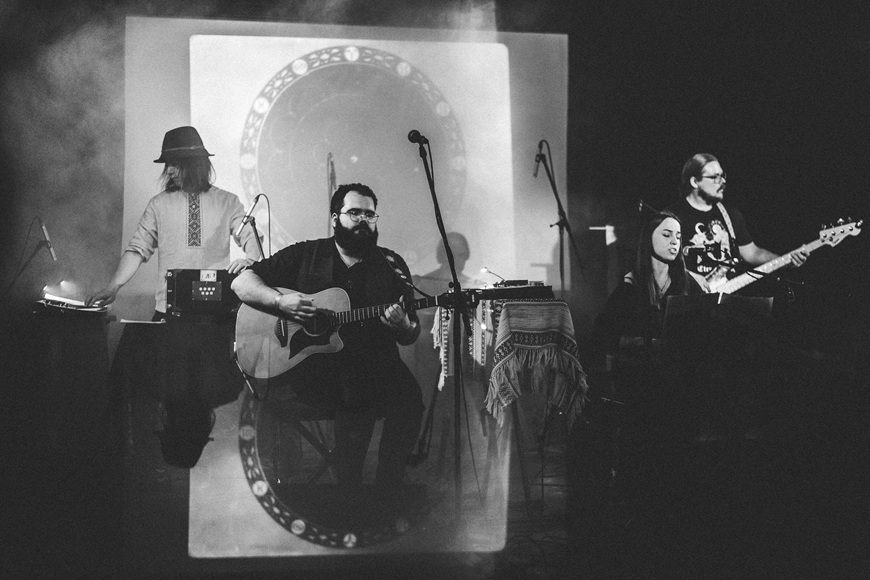
– Regarding “togetherness” in the context of live shows, performances of the band should be something that can bring together people of similar interests, and also bring down barriers between artist and audience. In my younger years as a metal musician I would try to do it through shocking the audience (diving into them while beating a big drum for example), but I think today my tactics are more gentle, and we try to create a shared emotional experience through the performance. I used to really pay a lot of attention to special aspects like incense, strange decor, etc, because I thought it helped create a unique atmosphere, but, to my slight annoyance, EVERY band does that kind of thing now, and its lost some potency. Same with artists wearing masks; this is due to it “looking good on camera”, and in the days before everyone was completely obsessed with putting everything on instagram, the impression that these kind of things could make was a lot stronger.
– We also started a label, Aetheric Recordings, and a two-day live festival, Aetheric Echoes, to further grow and support other bands who we’ve met on our travels and fit into this new vision of “Aetheric” music. Which is a somewhat difficult category to define, but I know it when I hear or see it. It doesn’t rely on any genre limitations or particular sound, it’s more of an inner feeling of resonance. I’m happy to say we’ve made friends of this kind from all across the continent in these five years.
Ian has mentioned before that one of the ills of the modern world is that we think we’ve got it all figured out. Would it then be correct to say that Crooked Mouth tries to shine a light on the vast abundance of things outside of that thin slice we know and in our hubris call “everything”, I ask.
– Yes, I would say that’s an apt description. What I’d like people to maybe understand is that there is beauty in mystery. There is beauty in so many things that the masses try to avoid. Ambiguity, confrontation, contradictions. I think this is where the force of life really lives; in those in-between spaces.
– There is also great power and liberation in casting off others’ ideas of “what is” or “what should be”. There is even more power in turning that gesture ruthlessly on yourself, and casting off even your own comforting assumptions. Easier said than done, but we can all benefit in some way from it.
All things are, in the end, cyclic. So at the end, we return to the beginning, to the tarot and the Fool’s journey. If Ian is indeed the Fool, the first card in the Major Arcana, what then is The World, the last card, in Ian’s journey?
– I suppose in my artistic life, I live for small moments of satisfaction, a feeling of completion. Releasing an album is like that. I got a similar feeling of inner satisfaction during the final performance at the first edition of our Aetheric Echoes festival last year. It’s a great feeling to overcome big odds and achieve some kind of new experience, especially being able to share that with others.
– Of course, it fades quickly, and I’m left looking to the next peak to summit. Where it ends, I can’t say at this point, but I am satisfied with improving and refining my creations, building community, taking bigger risks, and enduring all the shit that the current world wants to throw.
– The World is a circle, or an ourobouros, so I suppose the only place to go is back around again.
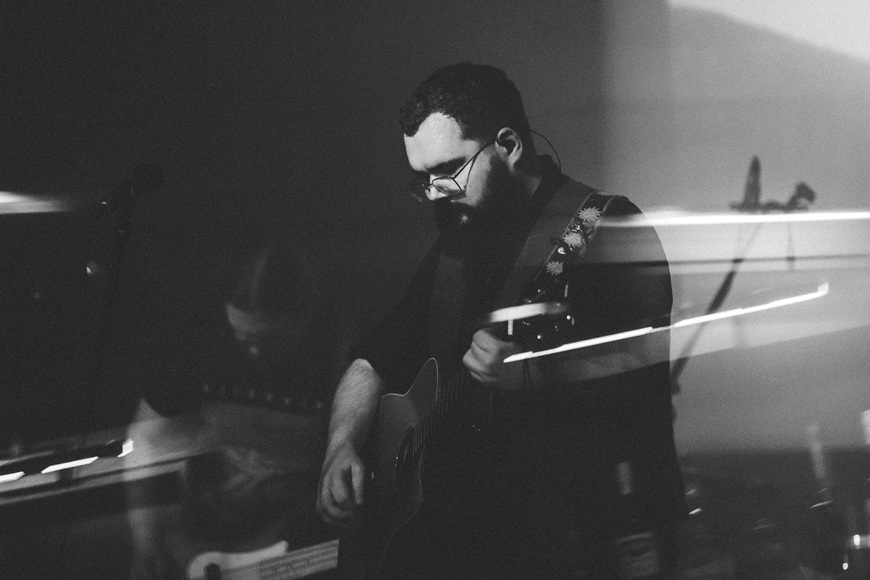
Visit Crooked Mouth on their official website, Bandcamp, Facebook or Instagram

