
Year: 2026
Label: Steelwork Maschine
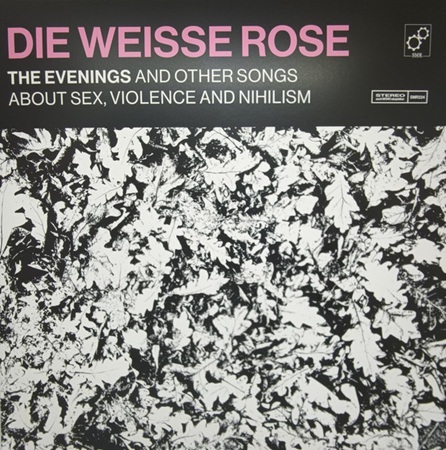
It’s hard to even pretend to be objective about Danish Die Weisse Rose’s second album, released only 17 years after the debut A Martyrium Of White Roses. The debut is, after all, a monumental but oft overlooked album within the field of post-industrial/neofolk. And, on a personal level, one of those albums that have had a massive impact; Dieux Des Cimetières‘ sound is in no small way indebted to Die Weisse Rose.
So let’s not pretend to be objective. This is a text written from the viewpoint of someone who holds Die Weisse Rose dear. Someone, who was overjoyed at the announcement of a new album. But also someone who, before pressing play for the first time, was filled with fear. What if The Evenings And Other Songs About Sex, Violence And Nihilism can’t live up to the expectations? What if it turns out to be a disappointment?
The past 17 years have, of course, been 17 years for Die Weisse Rose as well. It’s unrealistic to approach The Evenings expecting it to sound like A Martyrium Of White Roses. And, certainly, it is different. But at the same time, very recognizable. Perhaps even to a surprising degree, considering bot the vast time difference between the albums, and the very different arrangement of the music.
Gone are the bombastic, militant percussions. Gone is the organ. Gone is the accordion. The Evenings strips down the sound to two instruments: piano and violin. And, of course, the voice of Die Weisse Rose’s founder and sole constant member Thomas Bøjden, who recites rather than sings the lyrics. It is sparse and stripped-down, but far from minimalistic.
One word above all describes The Evenings: intimate. The Evenings is an incredibly intimate, vulnerable and personal album. It’s an album that stands with its arms open, entirely naked, bearing no masks or harbouring no pretense.
It’s in Bøjden’s voice, his deep, husky and emotional voice, which convinces the listener Bøjden is speaking directly to them. It’s in the beautiful, tragic and fragile arrangements, where the interplay of the piano and violin add a second voice that speaks just as directly to the listener; just without words. And it’s only accentuated by the field recordings used to great effect on the album – the non-distinct ambience on The Length Of Your Body, the train tracks on (We All Are) February 24th, the patter of rain on The Impossible Love.
An easy word to use would be cinematic. And whilst it does illustrate what I’m going for, I don’t think it goes deep enough. Listening to The Evenings is not like watching a movie – a great, powerful tragedy of love and bereavement – it’s re-living a memory of something that never happened to you. The Evenings is personal in two ways: in the authenticity of emotion in its music, lyrics and delivery, but also in how it touches the listener on a profound, quintessential level. Inevitably, The Evenings becomes personal to the listener.
Where A Martyrium Of White Roses had lyrics I’d perhaps describe as mythopoetical, reaching deep into a cultural subconscious and memory of history, here too The Evenings is far more intimate and personal. Its lyrics speak of passionate, absolute love; of complete disillusionment; of tired resignation; of loss and of tragedy. On one hand, it is a very ahistorical album, not tied to any time or moment, but on the other, it is an album that could not have been created at any other moment in time.
The war in Ukraine (Bøjden dedicates the album to the people of Ukraine) is a constant presence, not contained just to the aforementioned closing track of the album, (We All Are) February 24th. The Evenings speaks of dejection, disappointment and horror, of the realization that dark clouds of an uncertain tomorrow block the sun; but on a personal instead of historical level. Of a last farewell to a friend, of holding your lover tight as the night closes in, of fiery passion when the world burns, and of riding on train tracks past cities with names we can’t read nor understand, towards some unknown destination.
The lyrics manage to reach something perennial through the temporal. Ukraine is in the back of the mind, but equally one could imagine people waking up to the realization that the Second World War has begun. Or the First. Or some other historical human tragedy, and the uncertainty they plunge the world and its people into. It speaks of a profound feel for the weight of history, of how insignificant we as individuals are under it, but how it still is of utmost importance that we as people stare into whatever storm approaches – not alone, but a brother’s arm in ours, and a lover in the warmth of our embrace.
Turns out, all my fears were unfounded. The Evenings is different from the debut, but in its own, different ways, it is every bit as monumental and powerful as A Martyrium Of White Roses. And perhaps even more: emotionally, The Evenings has more gravitas, more weight.
Whilst it is natural that Die Weisse Rose is forever embodied in Thomas Bøjden, and his voice is at the centre of The Evenings, the album is equally the triumph of Cornelius Waldner on piano and Aloma Ruiz Boida on violin. They’re no session musicians on this album; they pour their heart, soul and deepest essence into their performances, and are in no small way responsible for the emotional potency of the album.
I don’t think my words do the album justice. The Evenings is an album that has touched me deeply, one that resonates in a profound sense. It is, as tepid as it might sound to say it, an utter triumph. It is most likely the most important album released this year.


2 thoughts on “DIE WEISSE ROSE: The Evenings And Other Songs About Sex, Violence And Nihilism”