
Year: 2026
Label: Impulsy Stetoskopu
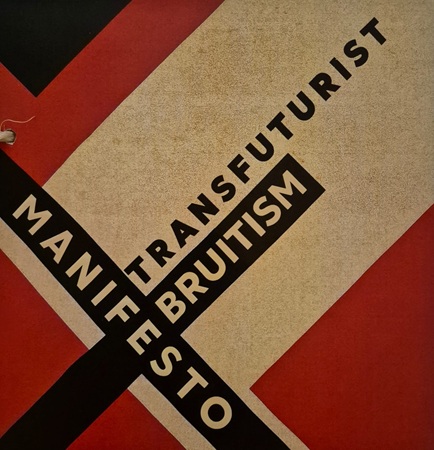
In the beginning of this year I published an essay titled Metaphysics matter (here). In it, I discussed the importance of a less reactive, more contemplative, metaphysical and philosophical approach to writing about music. Polish Ars Sonitus truly force me to put my money where my mouth is with their new release, which is both an album and a manifesto.
The hand-bound hardcover book the release is presented in states that the text and the CD are not companions but, to quote, “Word and noise /…/ constitute two modes of disclosure of the same reality.” In other words, what the manifesto expresses in words, the CD should convey through the medium of noise. The manifesto states that the conceptual layer of a release – which the manifesto obviously is in this package – should not serve an explanatory function; it should not “serve to close off the meaning of the music.” To be honest, it’s somewhat hard to avoid reading the text and NOT have it define what is heard on the CD and interpretations of it. Which is one of the core themes of this review: to what extent does the noise/music communicate the same ideas as the text, and on the other hand, to what extent does the text define and delimit the audio?
Transfuturist bruitism is, to paraphrase the manifesto, a revalued form of bruitism – invoking Italian futurist Lugi Russolo and French philosopher Jean-Marc Vivenza – in which noise takes on the role of something that reveals the impermanence of things, and also disassembles the conventional roles of creation, creator and consumer. Following the manifesto, a transfuturist bruitist views noise as something transcending both the paradigm and the conventional definition of art. To them, noise would be motion, transition and potential; not a rigidly defined thing, an object, but a perpetual transitory, liminal state that comes before boundless potential collapses into a singular definition.
Transfuturist bruitism is contrasted to industrial, which is defined as a “ludic form” of bruitism developed outside the academic milieu, in which noise is essentially reduced to aesthetics. Considering this is discussed in a chapter called Profanation of noise in industrial music, it’s hard not to read a valuation into this division. Perhaps, from the manifesto’s view, noise emerging from the “industrial sphere” is to be seen as subjective to the point of being flawed, and irreparably reduced to the conventional creator/creation/consumer paradigm mentioned above; in purpose if not form a traditional piece of art. This is a rather provocative juxtaposition, as it is all too easy and even natural to infer that profane equals lesser.
How to reconcile the manifesto with the music, as obviously must be done? Analyzing the technical execution of the two noise pieces on the CD – the first divided into four tracks, and the second one long track – is not the solution. Not only has that always struck me as counterproductive as a noise listener and reviewer; the spirit of transfuturism is not to be found there, as per the manifesto: “No technique /…/ is in itself transfuturist.”
Instead it says of technique: “Their value is determined neither by their name nor by their intensity, but by whether they avoid reducing noise to a form that can be wholly domesticated.” And in the concluding words of the manifesto, the mindset of the transfuturist noise creator: “Does it still destabilise, or has it already become merely a representation of destabilisation?”
Which, as direction to the listener – as a listener – I transpose roughly as: noise should engage me more directly, more actively than conventional music. The manifesto states that the listener should be removed from their traditional safe position as passive recipient. Instead, they should actively engage with the noise, which to me doesn’t sound entirely unlike what I wrote about listening to martial industrial in another essay, albeit more from a philosophical and/or aesthetic viewpoint (Ambiguity as the heart of martial industrial). The listener must be confronted, not given ready chewed, easily digestible content.
So let us look for transfuturism in the noise itself.
The audial half of the Transfuturist Bruitism Manifesto isn’t noise as you’ve never heard it before. It doesn’t go out of its way to create some new kind of noise (which isn’t the point of the manifesto anyhow). Rather, it’s quite a familiar fare. There’s abrasive and harsh distortion; whirring machines; decaying loops; samples manipulated to near unintelligibility. Die Lichtung, the third and longest part of the first piece, Lux Tenebrosa, sounds like massive metal objects tumbling and falling again and again and again, blaring with excess distortion. The second piece Λόγος της μηχανής του νου (which apparently translates to Reason of the Mind Machine) is less abrasive, consisting of slowly evolving or decaying machine rhythms: perhaps a turbine and a tumbling barrel of some sort. Junk metal abuse and what sounds like a moaning, wailing human voice add cacophony.
On a straightforward level of keeping music as music – or noise as noise – this CD is good. It’s brutal and unrelenting, but also very dynamic, using both contrast and gradual transitions to effectively stave off monotony. The loops never start to grate too much; they aren’t too pronounced, and instead of being static, they shift or degrade subtly over time. A particular highlight to single out is the seamless shift between the tracks Dal Futuro Al Passato and По ту сторону линейности рождения и смерти (both part of the first piece, Lux Tenebrosa) – an orchestral sample shifts to blaring noise violence in a rather classic fashion, but to great effect. I especially like how the sample, which would typically be put in the beginning of a track as “intro” is instead right at the end of the previous track. It’s a small detail, but that’s where the devil is, right?
But, transcending the “material” – Does Ars Sonitus force or drive me to engage with the music more directly than, say, a gorenoise act?
That’s a tricky question, and to some extent I feel that the impossibility of not having the concept define (and, by defining, also limiting) the experience rears its head here. Entirely on purpose, I listened to the CD before reading the manifesto, having no knowledge of what the manifesto was about. And, I must say, that I listen to the CD with different ears (and thoughts) after reading the manifesto, paying heed to how degrading loops express impermanence as opposed to the artifical permanence of static loops, and how samples are carefully used in a way that will not define or explain the noise. The concept does have a significant impact on the listening experience, determining interpretations.
Noise is rather typically described as the music of collapse, disintegration and order breaking down; this is also represented in the often rather negative thematics of noise. The sensory overload of blaring white noise might be considered representative of a demolishing explosion. The manifesto argues that, rather, the cacophony and information overload should be seen as akin to a limitless horizon of potential anteceding solidification into singular forms and objects. Noise is not form, or destruction of form, but the liminal and transitory movement from pure potential towards form; but it should never reach the state of form and allow itself to be reduced to an object.
That’s a very compelling thought, and the manifesto opens up new horizons by presenting noise as something else, and something more, than a tearing down of things; as a field ripe with potential. I would also say that, to some extent and on a more instinctual, guttural and unverbalised level, this has always been one of the ways to approach noise; in a pareidolic fashion, as a listener, observing the abstraction and the apparent chaos, finding patterns, meanings, significancies and interpretations in it. In the process, the chaos receives subjective meaning – ergo, I as a listener have participated more directly with noise than I would with some other form of music.
But does Ars Sonitus’ noise, its transfuturist bruitism differ from other – perhaps “lesser” – forms of noise? Honestly, save for the omission of samples, visuals and track titles that would explicitly and exhaustively define the context of the audio, not really. Even after having read the manifesto, and allowing the text to impact my listening experience, which potentially is contrary to the spirit of transfuturism as defined in the manifesto, it doesn’t strike me as being decidedly more potent, transcendent or elevated than most other noise. By a conscious act of disregarding context, I could find the same levels of depth and potentiality in noise made from more banal, traditionally artistic premises.
In essence, as a listener, I find it hard to identify from noise without explicit context whether it actively destabilises or merely represents destabilisation. That’s the crux here: on the first spin, without having read the manifesto, I quite liked the music, but it didn’t really stand apart from the average noise release by essence. More ambitious and ontological interpretations emerged only after reading the manifesto.
So, let’s attempt to answer the question posed previously. The manifesto does make me engage with the music on a different, more active level. In this sense: yes. But this is applicable to noise in general, not just Ars Sonitus, and the music on the CD without the manifesto doesn’t open itself up to me in a drastically different way than any other noise of similar quality. In this sense: no.
I wouldn’t be surprised if this dissonance is purposefully left an open question in the manifesto, because it does create an interesting abrasion in the listening experience. In applying the transfuturist ethos to the music, does one reduce the audial part to an object defined by the concept (“this is what the artist meant”)? Or does it free one from subconscious fetters of enculturation and convention, to experience and engage with noise more purely, more directly? Becoming conscious of this polarity makes the listener a more active participant, which moves them away from being a mere passive recipient – which is one of the stated aims of transfuturist bruitism.
As proven by the amount of words I’ve minced, both as text, music and idea, the Transfuturist Bruitism Manifesto is definitely something for the more philosophically or metaphysically inclined noise listener to get acquainted with. In detailing a new, even radically new way of approaching both creation and consumption of noise, it doesn’t exactly present easy or straightforward ideas, but it does it in lucid and confident writing that is sure to provoke thoughts.
Of course, one can also ignore the whole philosophical framework and listen to Transfuturist Bruitism Manifesto as just a good noise album in really nice packaging. In a sense, this too is important. Audio reductible to mere accompaniment easily comes across as an aferthought, which would appear to be against the spirit of the manifesto, context dictating form. But it would be a bit of a waste to do so, considering the manifesto is a conceptually ambitious work. However, as discussed above, it is questionable whether on its own the music communicates on a subliminal, transcendent level the same as the manifesto does in plain words – the tension remains.
(All rights to have completely misconstrued the manifesto reserved.)
Ars Sonitus doesn’t appear to have an official online presence, but visit the label’s Facebook group for more info


One thought on “ARS SONITUS: Transfuturist Bruitism Manifesto”