
Year: 2026
Label: Misantropia Records/Ambirial Mvsic Productions
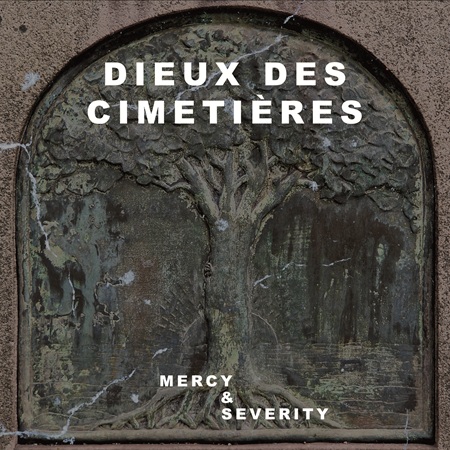
Like our text on Dieux Des Cimetières’ previous album, 2024’s Säkeitä esoteerisesta Euroopasta (here), this is not a review, but a text discussing the concept of the album its themes and its influences. After all, it’d be mighty questionable to write a review of one’s own album, wouldn’t it?
Dieux Des Cimetières, or DDC for short, is your’s truly’s primarily musical and artistic vehicle. It came into existence in 2017, and after the slew of demos, the first album European Fire was released by Steinklang Industries in 2020. Mercy & Severity is the first album not released by Steinklang – but I’m going to have to disappoint anyone expecting scene drama. No drama was involved, and in fact I included Steinklang in the thanks list of the album, as I have nothing but good things to say about the label.
Mercy & Severity was born from two very disparate early strands. The first was a desire to return to pure martial industrial with an emphasis on domineering, powerful percussions after the more atmospheric and neoclassical Säkeitä esoteerisesta Euroopasta. Conceptually, however, I wanted to explore western esotericism further, and continue the move into more metaphysical territory commenced on the previous album. For a time these felt at odds with each other, refusing to coalesce into a meaningful whole.
The slogan of the album, if it can be so called, is borrowed from the lessons of the Hermetic Order of the Golden Dawn: “Unbalanced mercy is but weakness, and unbalanced severity is cruelty and oppression.” This phrase provided the solution to bring the two separate paths together. The key was in allowing for a certain contrast between mercy, or tracks of a more atmospheric and contemplative bent, and severity as represented by the more martial, bombastic tracks.
Implicit in the album’s conceptuality is the middle pillar, and the middle pillar ritual which was central to the Golden Dawn, and has equivalents to be found in other traditions, for example freemasonry. The middle pillar represents a striving for balance, of man standing in the middle of the cosmos uniting opposites such as light/dark and mercy/severity. The concept of man as a mediator between and unifier of polarities is a rather universal concept, and, as it were, in a central role on the album.
Other sources of thematic inspirations were Aleister Crowley and Thelema, as well as Kenneth Grant’s so-called Typhonian Trilogies. The latter inspired very directly two tracks, and in a roundabout way inspired the title of a third track. The album’s epilogue, Qliphothic Encroachment, is adapted from Grant’s Nightside Of Eden, whilst the instrumental Allala (which can be rendered as “God is not Not”) is inspired by various passages where Grant muses on Frater Achad’s elucidations of Crowley’s concepts. Grant also provided inspiration for the title of Mars Martial Magick, although the lyrics of the track are more indebted to Giuliano Kremmerz, which anchors Mercy & Severity to the same continuum as the previous album – Kremmerz inspired its opening track very directly.
I think it was Gene Simmons of Kiss who once said that the first song you write for a new album should be its first track. I haven’t always followed this rule, but on Mercy & Severity I did. There’s a surprising and perhaps unintended profundity to this idea: the first track written will, inevitably, in some way provide direction and focus to the whole album, and as such placing it first will on some subconscious level convey that same focusing lens to the listener.
For Mercy & Severity, After The Fire certainly sets up the scene, especially as far as severity goes. Its thoroughly oppressive and even apocalyptic soundscape complements the lyrics. They are inspired by a 1940’s propaganda image proclaiming that “After total war can come total living” – a powerful slogan that has undertones of a rather bleak totalitarian attitude, which the lyrics attempt to convey.
After The Fire is followed by Kuoleva jumala, a retelling of the universal myth of the Dying God, where the Divine Mother gives birth to a son, who matures to become Her consort and impregnates Her before being killed. This universal myth pattern symbolizes the cyclic nature of time and the recurrence of phenomena. I can’t for the life of me remember who put forth the idea that it’s not just the eternally born and dying consort of the Divine Mother who is renewed each cycle, but that the Divine Mother is also new every time (which also does away with the incestual nature of the myth). This paints the whole story as a tragedy, as the Divine Mother sees both Her lover and Her son die before fading into obscurity. It was this notion that inspired the track, despite being written from the viewpoint of the God-consort. At any rate, beneath the surface layer of tragedy, this track does seek mercy rather than severity – the mercy of the passing nature of things, even the sadness of gods.
The two first tracks also illumine the musical spectrum of the album. After The Fire is very much a classical martial industrial track, whilst Kuoleva jumala focuses on melody and melancholic atmosphere. The tracks of a more martial bent – aforementioned Mars Martial Magick is another example – opt for a stripped-down structure and arrangement in favour of a few powerful elements, percussion in particular. The arrangements are sparse and the melodies simple, so as not to steal power from the dominating central elements.
Many of the more atmospheric, neoclassical tracks such as Who We Are focus on the interplay of typically two strong melodic instruments. I’m the first to admit my skills as a composer and arranger are limited at best, but I would still say especially Who We Are and the lengthy intro of Historian taivaanranta – which evolves towards martial bombast during its second half – are among the most accomplished and complex arrangements I’ve done with DDC so far. This is another of the many intentional contrasts on the album, although the contrast is somewhat blurred by the running order of the tracks. I did toy with the idea of having a “Mercy Side” and a “Severity Side” with stronger contrast between the first and the second half of the album, but it didn’t work as well.
Moodwise, the album can be characterised as melancholic and somber. Which was actually a bit surprising to me – I didn’t intend for the album to have such a blue atmosphere! Tracks such as Kuoleva jumala, We Came To See The Sun (whose violin melody I think works very well!) and Who We Are somehow define the atmosphere more than the martial bombast of After The Fire, Mars Martial Magick and Allala. But, like Säkeitä esoteerisesta Euroopasta before it, Mercy & Severity should still not be perceived as a depressed or defeatist album. Despite a certain downcast leaning, there’s also light to be found – after all, Power is given to those who claim it, and Magick to those who rise to it.
Where Säkeitä esoteerisesta Euroopasta sought to present a perspective on the hidden currents of Europe, its spirit and traditions, Mercy & Severity keeps the interplay of light and shadow, but shifts it to an ever more metaphysical and conceptual level. It explores the dualisms at the core of our existence, which can, again referencing both Crowley and Grant, be expressed by the mystical equation of 0=2
Furthermore, the album draws inspiration from classics of western esotericism, but is not content with broaching its subject with detachment or academic distance. Instead, it is born from an active and personal involvement; the middle pillar around which both mercy and severity revolve was not an abstraction, but a very concrete reality in the making of this album.
But, as always – the extent to which the album actually succeeds in transmitting any of the above to the listener is left entirely for the listeners to ascertain.
Buy the CD from Misantropia Records’ webshop or from Dieux Des Cimetières’ Bandcamp. You can also stream it from Spotify. Learn more about Dieux Des Cimetières via Facebook or Instagram.


One thought on “DIEUX DES CIMETIÈRES: Mercy & Severity”