

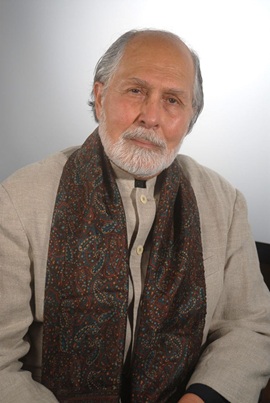
Seyyed Hossein Nasr (b. 1933) is a proponent of the Traditionalist school of philosophy, and one of the most prominent Islamic scholars active within western academia. In his book Traditionalism: The Radical Project for Restoring Sacred Order, Mark Sedgwick places Nasr alongside René Guénon, Julius Evola and Frithjof Schuon as figureheads of Traditionalism. Despite this, he seems to be relatively unknown among many European adherents of Traditionalism.
His book Man and Nature: The Spiritual Crisis of Modern Man, originally published in 1968, contains four lectures Nasr delivered in 1966 at the University of Chicago. In these essays, he presents a Traditionalist, spiritual perspective on environmentalism and calls for a necessary re-evaluation of our attitude towards nature. This was a radical position in an age before the modern environmental movement took form, and is an unusually concrete application of Traditionalism.
Nasr’s framework is very classically Traditionalist in many ways, owing especially to Guénon and Schuon, but to some extent also Ananda K. Coomaraswamy. This means in particular a very heavy emphasis on Christianity as a form of Traditional spirituality available for the west. This heavy emphasis is something I disagree with, and side myself more with Evola in his call for pagan restitution. Despite its long history in Europe, Christianity is not the original form of European Tradition. How pure the initiatory line to authentic, original European Tradition is can be questioned. Is there not a risk of the taint of syncretism in Christianity, that Traditionalism so warns against, considering its non-European origins? I see a return to pre-Christian spiritual traditions as preferable, at least on an individual, personal level.
Of course, Nasr’s environmental perspective necessitates more than an individual restitution of Tradition and Traditional metaphysics. Integrating this with the above, Christianity could be viewed as a stepping stone or link on a path back to a genuinely European Tradition, especially considering the many reservations even Nasr has towards Christianity. One criticism he directs towards Christianity is its absence of Sacred Law in the sense of Islamic Shari’ah and the Talmudic Judaic Sacred Law; other reservations Nasr expresses relate to how Christianity separated man from nature. Via this separation in Christian theology and philosophy, Christianity enabled Western science to diverge into wholly materialist directions without any metaphysical dimension. Ultimately, metaphysics have become absent from the majority of Christianity; especially from a Northern European view, the Protestant churches would seem to be particularly egregious offenders.
Nasr’s criticism of Christianity does not amount to a dismissal of it; like Guénon, he does view it as the primary means towards Tradition for the west. However, he laments its historical loss of esotericism and metaphysics. This argument could perhaps be expanded upon beyond Nasr to question whether it is any longer possible for Christianity to restitute genuine metaphysical esotericism, or whether the more viable alternative would be to seek a return to even older forms of Traditional spirituality.
Nasr argues that man must radically change his relationship with nature in order to avoid total ecological destruction. Environmental protection alone will not suffice. We must resacralize nature, and make it Holy again on a deep, profound level. Further, Nasr argues that our relationship with nature has been, and is defined by the terminology of war: we either wage war on nature or conquer it. In this, undoubtedly Nasr is right. Not only the terminology, but also the attitude it represents is thoroughly that of an imperialist conqueror. We speak of nature in terms of ruling over it, of exploiting it, and even in pro-environmental perspectives it is common to speak of nature deeply anthropocentrically. What is the value of unspoiled nature to us, how will it be beneficial to man? Nasr calls for a re-evaluation through resacralization.
Nasr traces Western development from the early stages of Christianity to the current day, and argues that resacralization requires putting metaphysics into an ontological focus. In a very Guénonian fashion, he calls for a return to quality over quantity, an end to the era of quantity supreme. Nasr observes that Western science, based as it is purely on measurable, quantifiable quantity, can offer only a horizontal level without a vertical. Nasr does not express it in these words, but it could be said that Western materialist science devoid of metaphysics can only speak of instrumental values: this is good because it enables that, etc. And this from a very anthropocentric view. The values science devoid of metaphysics can express are purely exploitative, aimed at making nature subservient and, in itself, instrumental to man. The addition of a metaphysical framework, which some might call spiritual, would allow to approach true value, an understanding of why things in themselves are valuable as part of the Absolute.
Metaphysics is not contrary to science, but complements it, Nasr points out. Or, more properly, guides it. A metaphysical framework allows seeing the different sciences in a larger system, providing an understanding of the qualitative value of both the sciences and their discoveries. A very real risk of the sciences is that, as specialization increases, they begin to less explain the cosmos as a whole and create ever more fragmentary understandings of reality instead. As knowledge specializes, no one can have a comprehensive understanding of the overarching picture. Nasr’s suggestion of a metaphysical understanding to guide the sciences would provide a “big picture” based on a qualitative understanding of how the sciences serve the ontological purpose of man.
And, as Nasr points out, although many tend to view only the scientific and material as real, this is in no way absolutely so. It is a decision we have made somewhere along the way, that only that which can be reduced to numbers and measurements holds any reality. The metaphysical, as a different axis providing quality, an axis exploring meaning and value, is just something we have chosen to shut outside of our sphere of experience.
Ultimately, Nasr argues, our desacralized understanding of nature and the ecological crisis it has resulted in reflect a deeper spiritual crisis in man. We have desacralized our own very being, reducing ourselves as well to pure quantity. This can be viewed every day in our modern society, where value is measured in quantities of wealth, productivity, popularity and visibility. Nasr’s call is for a deep, fundamental resacralization of ourselves. In this metaphysically symbolic existence, just as nature symbolizes The One, our attitude towards nature symbolizes our deep existential, spiritual crisis of being separate from nature, hopelessly cut off from the Absolute, entirely devoid of means to transcend towards it.
Modern man must make his way back to a path leading towards the Primordial Tradition, and rediscover the sacrality of nature, not as an instrumental value for something else, but in itself, and finally reach an alchemical Rubedo of reintegrating with his own sacrality.
Visit Seyyed Hossein Nasr’s website for more information
 Only Death Is Real