
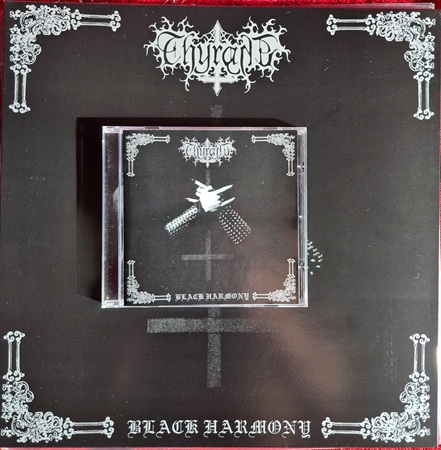
If you were Finnish and into black metal around the turn of the millennium, most likely you were familiar with Thyrane. And if you were from anywhere else, odds are you never heard of them, let alone heard them. Such was the world back then, before streaming platforms and well-established international distribution networks.
Which is probably one of the reasons why Thyrane’s first release, the hard-to-define Black Harmony, is rather overlooked despite being an absolute gem of late 90’s underground black metal. If quality really was the decisive factor, this would be a household name.
As mentioned, Black Harmony was the group’s first release, originally put out as a demo tape. The group from Kemi, Finland had already been playing for some years, but had never released anything – and Black Harmony can well be described as a bolt out of the blue. It’s no wonder budding Finnish label Woodcut Records hurried to pick up the band, and in no time the demo was put out on CD. Which begs the question, what is this then: a demo or a debut album?
Taken as a demo, there’s no way around it. This is one of the best demos ever, in absolutely every sense. It presents a band with a fully formed sound and identity (we’ll return to this identity later…), a sense of aesthetic, more than adequate compositions, accomplished musicianship, great production and a sound that gave even established names a run for their money. The only quibble – and considering all the strengths mentioned before, a less than miniscule one – is that Black Harmony wasn’t overly original.
Taken as a debut album, all of the above apply still. Verily, Black Harmony’s maturity is astounding considering band leader and vocalist/drummer Blastmor was, unless I’m mistaken, in his early twenties when composing and recording this – with his first serious band.
Stylistically, Black Harmony closely held it’s finger on the pulse of the times. This is dark, meandering, epic, symphonic black metal of a decidedly northern kind. The whole nine yards of the standard blueprint: buzzsawing tremolo picked guitars playing cold, melodic riffs; blasting tempos; plenty of atmospheric, orchestral synth arrangements. Of course, there are the mandatory atmospheric, acoustic interludes and pitch-shifted low spoken word passages. Think early Emperor.
Some might say this lack of originality is the reason why Thyrane never gained more traction in the international scene. But I call that into question: a great many lesser bands with no more originality had their moment in the sunlight. Or moonlight. Whatever. Musically, Black Harmony only presents reasons why Thyrane should have been more known.
Admittedly, some of the tracks meander a bit too much. I suppose it can be said that on occasion, Thyrane’s ambition exceeded their skills, and some of the sections don’t gel together particularly well. And there are sections aplenty in these tracks, considering the shortest of the four tracks runs just shy of eight minutes. But again, this is hardly a unique flaw of Thyrane, and more of a very common characteristic of the times. In the context of their competition at the time, despite the occasional fumble, Thyrane were far from the worst offenders. For the most part, Black Harmony’s tracks hold together.
I reiterate: Black Harmony should have been bigger.
Recorded and released as a demo in late 1997 (the original CD edition came out in early ’98), Black Harmony has withstood the test of time admirably well. Even at almost 30 years old, it sounds vital, powerful and relevant today, not just a romantic curiosity for people into nostalgia. In exactly the same way as Emperor’s In The Nightside Eclipse sounds simultaneously like a product of its time and timeless, Black Harmony will on one hand evoke nostalgia, but on the other impress entirely independent of fond memories of yesteryear. The primary difference between Emperor’s seminal classic and Black Harmony is of course that where Emperor created the playbook, Thyrane adhered to it.
Black Harmony captures the essence of the Emperor-pioneered style of nocturnal, symphonic black metal. It paints images of dark forests, majestic wintry mountains, arcane mysteries of Satan and mysterious realms of fantastic entities.
In a nutshell, what Thyrane accomplish with Black Harmony is tapping into the quintessence of this style of black metal. It does not need lyrical excellence to communicate the dark, somber beauty and deep, nocturnal mysticism inherent to the music – the lyrics are pretty clumsy, stereotypical and written in broken English. Black Harmony emanates visions of dark wintry skies, frozen mountainous horizons, the beauty of night and the call of the adverse side with the immense strength of its music in a way that transcends its stilted lyrics.
Perhaps one reason why Thyrane never made it bigger is that despite Black Harmony’s powerful identity, overall the group’s musical identity appeared rather weak. It seems like Thyrane could never really decide what they wanted to be, which led lamentably to a downward trajectory in terms of quality.
Black Harmony’s successor, 1999’s Symphonies Of Infenality, was essentially in the same vein, but despite being a fine album, is not quite as good. The Spirit Of Rebellion (2000) started downplaying the symphonic elements and include some more rocking elements, clearly distancing itself from the earlier albums, perhaps slightly mimicking Satyricon’s development. The real kicker, however, was 2003’s Hypnotic, which saw the band jump on the industrial extreme metal bandwagon, following what more than one Norwegian act had done some time before. Thyrane’s final album, Travesty Of Heavenly Essence, tried to rewind the tape, but – too little, too late. And soon after that, the band called it a day. They have since reformed, but no new material has been released.
As such, it is understandable that Thyrane failed to make much of an impact: with each album veering in some new direction, the key element of consistency was absent. It’s hard to build a foundation on that. However, be that as it may, Black Harmony stands as an impressive monument among debut releases within late 90’s black metal. Write off Thyrane as a band for their flimsy inconsistency if you want to; Black Harmony’s excellence remains untarnished by that.
In From The Vaults we take a dive into the record collection at Only Death Is Real HQ and write about about items of iconic stature or personal significance; rarities and oddities from the archives; obscure gems that deserve more attention; classics of yore deserving of a moment in the limelight; and so on.
 Only Death Is Real