
Year: 2026
Publisher: Black Front Press
Available in: English
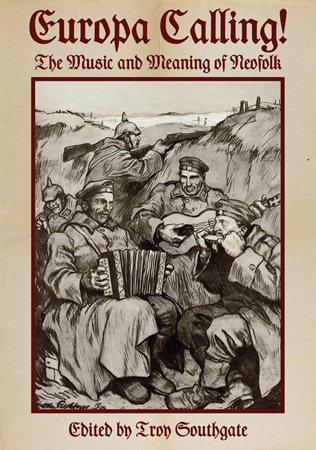
As established by Aleksandar Sazdovski in his intriguing analysis of Blood Axis in this essay anthology, neofolk is – or at least can be seen – as more than just a form of music. At the best of times, it is something of a gesamtkunstwerk, a complete work of art that encompasses a wider field of art. At its worst, it is, of course, something rather sad and laughable, as is the necessary flipside of a coin the kind of which neofolk is.
And what is neofolk? As the subtitle of this volume, The Music and Meaning of Neofolk, implies, this is what Europa Calling! sets out to explore via a series of essays on primarily various artists in the genre. More all-encompassing musings and dissections of the genre as a whole are largely absent from the anthology.
The first essay, by Michael “Dev” Victor of While Angels Watch, Joy Of Life, Sixth Comm and more, sets the scene by providing a deeply subjective first-hand account of the early days of neofolk. In what comes across almost as an oral history, Victor reminisces on his youth in the 80’s as part of the punk, skinhead and post-industrial scenes, including encounters with various groups and personae who would be integral to the formation of neofolk. Unlike the rather clean-cut and streamlined depictions of neofolk history provided by retrospective books such as Andreas Diesel’s and Dieter Gerten’s Looking For Europe, in Victor’s reminiscing the nascent days of the genre come across as a chaotic admixture of subcultures, lifestyles, ideologies and outlooks – as the early days of any genre and subculture are.
From there on, with the help of a multitude of authors, Europa Calling! provides a fragmentary and sometimes uneven look at neofolk, often through a very subjective lens that provides, apart from whatever the essay deals with, a narrow window into the minds of the authors, often active within the genre in some capacity. For example, Miklós Hoffer of H.E.R.R. and Xiphos (both projects we’ve covered, and both projects also featuring editor Troy Southgate) discusses French Dernière Volonté with much personal reflection.
What this means is that if one is after a more comprehensive, objective overview of neofolk as a genre and its history, this is not the right book. Which is absolutely not a point of criticism, it’s just something that’s good to understand beforehand.
I do have some points of criticism, though. The most major one is that many of the texts could have done with a bit sterner editing. Some of the essays make interesting points or observations, but are untight, either suffering from somewhat vague phrasing of key points, or unnecessary repetition. A good example is Graziano Ciccarelli’s essay on Italian Ianva. It lays superlatives on a bit too thickly, which is accentuated by repetition and structural untightness.
Some other essays would have benefited from a bit more critical, questioning attitude during editing. For example, Ismo Meinander’s essay on Darkwood mentions a couple of times that the author does not speak German and has as such largely overlooked the German lyrics of the band. Leaving out the German material of a band with many key songs in German seems like a pretty serious omission. It does not necessarily invalidate Meinander’s analysis, but it does put it on shakier ground. On another note, I’m not so sure I would call Darkwood’s lyricism ultra-nationalist as much as unashamedly and possibly subversively national romantic; but that’s an irrelevant tangent here.
I also somewhat question the approach Alexander “Hugin” Karrila takes on his essay on Allerseelen, focusing largely on listing and detailing the Austrian artist’s extensive discography, leaving discussion of the artist into a minor role. Considering Allerseelen are still most active, this puts a rather tight best before date on the text.
Many of the more in-depth texts are left to the end of the volume, with aforementioned Sazdovski’s analysis of Blood Axis, Resonances of Beauty: Blood Axis and the Reactionary Aesthetic Ideal closing the book on its highest note. Sazdovski presents his arguments with clarity and context, describing not only Blood Axis’ music, but also lucidly, although by necessity summarily, a reactionary ideal rooted in Evolian traditionalism. Manuel Dugos Pimentel’s analysis of Sol Invictus’ seminal Revolt Against The Modern World is likewise a fine text, although considering Tony Wakeford has admitted to not reading Evola’s main work of the same name when writing the album (according to Looking For Europe), one has to wonder if Pimentel’s analysis doesn’t give the album’s philosophical depth a bit too much credit.
As is perhaps not surprising, most of the texts in the book approach neofolk from a traditionalist, conservative and/or reactionary viewpoint. It is of course true that this is a prevalent if not necessarily always dominant or particularly profound viewpoint in neofolk – I doubt every neofolk artist proclaiming every act of beauty a revolt against the modern world understand what it is they’re really saying beneath a cool slogan – but it would have been interesting to provide a bit of counterpoint with an essay from a strongly differing or even opposing viewpoint. There is after all neofolk that is not traditionalist; heck, there even exists leftist/anarchist neofolk such as the “left/folk” movement. But this is the most minor of quibbles.
Europa Calling!, then, is not a general volume on neofolk for a wider audience. It’s very much an anthology by and for people already in the neofolk scene. It provides a series of fragmentary reflections and discussions on neofolk, which do not even attempt to paint a larger, comprehensive picture. Instead, the possibility to piece together some more over-arching realizations or revelations is left to the reader. This is, needless to say, a perfectly valid and even sensible approach to take: not every genre book needs to attempt an Ultimate Explanation of a genre. In many ways, when it comes to something as complex, multi-faceted and, often, internally contradictory as neofolk, it might be better to not even attempt that.
Europa Calling! is, despite my points of criticism above, an interesting addition to the rather scarce literary dissection and analysis of neofolk from within the genre itself. (There are plenty of essays from without the genre seeking to analyse and explain it – often more or less flawed in either arguments, conclusions or assumptions.) For those with a somewhat in-depth knowledge of the music and its themes, Europa Calling! provides interesting viewpoints and interpretations that occasionally could do with a bit more literary polish.
For more info, visit Black Front Press on their Substack or Facebook
 Only Death Is Real
Mostly enjoyable book but the article about IANVA was a huge disappointment, it mostly repeats surface-level, easily available information. That combined with the repetitive praise and meandering structure you pointed out; the sudden switch to past tense to describe a band that’s still active; the various “It’s not X, it’s Y” sentences and the “In conclusion, …” paragraph makes me suspect AI usage. Shameful if that’s the case, IANVA deserved so much better.
LikeLike