
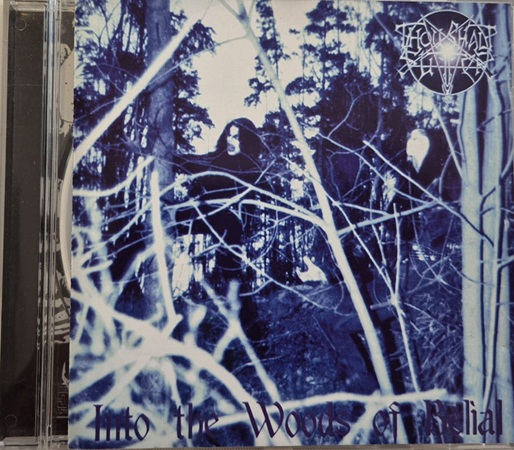
I’ve waxed poetical about the mythical days of yore, when not every nugget of information was available online and us teens of the 90’s would buy albums solely based on the album cover, title and the track names. See for example an earlier foray into the vault, Winter’s Into Darkness/Eternal Frost.
This was another of those “cool cover, cool name!” purchases. An atmospheric cover of corpsepaint clad figures in a forest, a simple but effective logo designed around an inverted pentagram, decidedly satanic/occult track titles. It was pretty much a sealed deal for me, though I’d never heard of a band called Thou Shalt Suffer.
Imagine my surprise when I opened the thin booklet only to discover this was an earlier project of Samoth and Ihsahn of Emperor. Plus some guy called Ildjarn, whose solo project of the same name I don’t think was familiar to me then.
Thou Shalt Suffer was a short-lived phase in the musical evolution of all three aforementioned members. Essentially the same group had existed as Dark Device, Xerasia and Embryonic for a year or two. They changed their name to Thou Shalt Suffer in 1991, recorded a small body of material but didn’t manage to survive to the end of the year. Emperor was formed in 1991, as was Ildjarn.
Thou Shalt Suffer’s style is usually labeled as death metal, which to some extent holds true on a surface level. The guitars are more down-tuned than what would become the distinct Norwegian sound is, and Ihsahn’s vocals are predominantly a lower, hoarse bark. Not so much “death growls” necessarily, though, and he does from time to time throw in a high-pitched shriek decidedly foreshadowing what his style would evolve to with Emperor.
But at the same time, there are plenty of elements that place Thou Shalt Suffer within a solid black metal context. The satanic and occult imagery and the corpsepaint, for one, but also musically. The group frequently utilize simplistic, eerie and haunting synths, the buzzsawing guitars are more black metal than death metal in style if not sound, and the overall feel of the music leans more towards black metal than death metal.
In truth, this is neither death metal nor black metal. This is a slice in time from those portentous years when second wave black metal began to establish its identity and sound, just like Darkthrone’s A Blaze In The Northern Sky (and Goatlord) and Marduk’s Dark Endless. The roots in death metal are still obvious, but the conceptual, thematical and musical shift towards something entirely new is already making itself evident. Just like the aforementioned releases, this compilation of Thou Shalt Suffer’s entire recorded output in this form captures that brief transformatory phase in time when future black metal pioneers started to break from death metal’s trajectory of evolution.
The result is a gloriously amorphous neither-here-nor-there style hybrid, which in my opinion reverberates with some of the most authentic darkness in metal. Into The Woods Of Belial’s material, like the other releases mentioned above, came before conventions and clichés of black metal were established. Thus Thou Shalt Suffer were able to very freely express their visions of occult, satanic darkness.
On the flipside, of course, it also means that Thou Shalt Suffer didn’t have many predecessors to look to for inspiration or reference. Where in the best of times Thou Shalt Suffer was truly inspired, truly unique darkness, at other times this lack of references and convention is heard in half-formed ideas, jabs that miss the mark and fumbling. In other words, as brilliant as some tracks are, at other moments Thou Shalt Suffer are blindly hobbling in an unformed darkness.
Back when I bought this in the late 90’s, I couldn’t hear many similarities between Emperor and Thou Shalt Suffer. That was actually one of the reasons I so like this release, which compiles together Thou Shalt Suffer’s two demos and sole 7″ EP: it was something totally different, something much rawer and far more primitive.
Now, with the experience and questionable wisdom of almost 30 years in music, I hear something very different. True, the sonic nature of Thou Shalt Suffer is quite different from Emperor, especially in regards to the role of synthesizers. Thou Shalt Suffer utilize very simplistic, rudimentary synth sounds and melodies, where Emperor’s sound would be defined by fleshed-out synth arrangements and intricate atmospheres. But still: compositionally, there are many moments here which bring to mind early Emperor. It is obvious that Samoth and Ihsahn were already firmly on the path that would make them trailblazers with their next project.
At any rate, Thou Shalt Suffer were far from a straightforward, simplistic death metal group. The songs tend to consist of multiple parts with stark rhythmic changes, varying tempos and more riffs than you can fit in a blender. At times it’s even a bit too complex for its own good. I think it’s pretty obvious Thou Shalt Suffer occasionally overreached, and the compositions meander too much. It’s when they keep things a bit more straightforward, such as on the title track, that Thou Shalt Suffer excel. But it wouldn’t be too long before Samoth and Ihsahn found the missing parts to complete the puzzle – and Ildjarn forsook the puzzle entirely for a far more boneheaded, primal approach to extreme metal.
This 1997 compilation, of which I own the first CD edition, is a nice if not somewhat basic package. It features quick comments by each three core members (drummers Ronny and Thorbjørn get no say). There’s a horribly photoshopped baphometic pentagram on the backside of the booklet, which is entirely appropriate for a 1997 release. Apart from that, the appearance is as obscure as is fitting for a project of this nature. Considering even the two demos sound quite passable, I assume the sound has been remastered at least somewhat.
Into The Woods Of Belial is a bit of a curio for the dedicated fan of Emperor, Ildjarn or early second wave black metal in general. It’s historical value comes from being a footnote to more significant projects, and a slice in time of the formation of second wave black metal. On a purely musical level, tracks such as the aforementioned title track and Spectral Prophecy with its haunting synths have stood the test of time rather admirably – so unlike some other demo recordings of the time, Thou Shalt Suffer’s recorded output actually bears listening to.
As a footnote to Thou Shalt Suffer’s short history, Ihsahn would resurrect the name later and release a sole album, Somnium. That had, however, nothing to do with metal of any kind and was an entirely neoclassical thing – or I suppose one might call it dungeon synth these days. So, despite utilizing the name and the logo, I think it is justified to look upon it as an entirely separate entity.
In From The Vaults we take a dive into the record collection at Only Death Is Real HQ and write about about items of iconic stature or personal significance; rarities and oddities from the archives; obscure gems that deserve more attention; classics of yore deserving of a moment in the limelight; and so on.
 Only Death Is Real
One thought on “From the Vaults #22: Into The Woods Of Belial”