
Year: 2025
Publisher: Star Regulus Press
Available in: English
A.W. Yrjänä, lyricist and vocalist of iconic Finnish rock band CMX once said in a documentary on occultism something to the effect of all great occultists also being con men. This was not a slight or a dismissal, but a rather insightful quip by a man who’s himself been interested and involved in the occult for decades: an occultist practically always embodies something of the archetypal trickster, buffoon or fool. To Belgian-British Gaston de Mengel (1875-1944), who was deeply involved in the esoteric and occult circles of the early 20th century, this applies very much to.
Gaston who, I hear many ask, even those among you who certainly know their occulture. This is exactly the question that Ike Vil, known from mystic rock bands Babylon Whores and Sleep Of Monsters, sets out to answer with Chasing The Green Dragon. Its subtitle, “French Occult Conspiracy, Nazi Mysticism, And Gaston de Mengel’s Journey to the East” describes well the book’s larger context. Gaston de Mengel serves as a focus through which early 20th century European occultism is viewed. And, conversely, the occult scene is explored in an attempt to learn about the mysterious Gaston de Mengel.

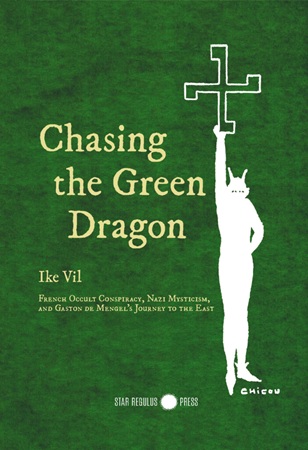
This means the book has two focal points, of which one remains foggier. Gaston de Mengel remains something of an outline, a vague figure like the one on the cover. But what can one expect, when we’re talking about a man of whom only one photo remains (included in the book), that doesn’t even show his face properly? de Mengel as a human and a person remains a mystery, as does his deeper cosmology and system of metaphysics, but Vil does uncover a lot about this odd esoteric in the book.
For some, occult-minded Finns in particular, de Mengel will be familiar from Yrjö von Grönhagen’s 1948 book Himmler’s Secret Society (our review). The Finn, who served with the infamous Ahnenerbe institute before the outbreak of the Second World War, depicts de Mengel largely as a buffoon and jester; a one-toothed mystic who hops and thrashes around, speaks gibberish and stages ludicrous rituals. Chasing The Green Dragon finds far greater depths in de Mengel, and offers a more nuanced, less buffoonish interpretation of him. Then again, as the book admits, many of his peers did consider de Mengel crazy. At the very least, he was skilled at burning bridges, and did not find his personal Promised Land in the Far East, but died in India an impoverished esoteric Don Quixote.
One of the greatest merits of the book is that it manages to present a method to de Mengel’s madness, so to speak. It meticulously explores the esoteric context from where de Mengel’s theories originated. Stories of The Greens, the man with the green gloves and the King of the World find their place in a larger esoteric framework. In this light, many of de Mengel’s ideas come across as far more consistent and logical – in an esoteric sense – and it becomes clear that he was not just the fantasist off his rails von Grönhagen described, but a man who was well versed in, and drew from occultural currents of his time. Chasing The Green Dragon succeeds in describing this without losing the trickster and buffoon in de Mengel.

The other focus of the book, which is often concentrated more on, is the esoteric scene of early 20th century Europe and France in particular. Through de Mengel, who seems to have been involved in just about every facet of interwar occultism, the book present a large cavalcade of persons: from A.E. Waite of The Hermetic Order of the Golden Dawn and the world’s most famous magician Aleister Crowley to notorious Nazi occultist Karl Maria Wiligut and the Cambodian prince Iukanthor – and, perhaps a bit surprisingly, René Guénon, key figure in Traditionalist philosophy. An equally breathtaking amount of occult organizations is presented, from theosophists to Polaires and beyond. The list of characters is long, and there’s little point in trying to keep track of everyone – you’ll just lose sight of the story, which is quite remarkable in itself. It runs through theosophy, Traditionalism and western magic tradition to Nazi occultism, conspiracy theories, intelligence services, the Russian revolution and Chinese triads, with de Mengel himself coming, going, appearing, disappearing and being rediscovered time and time again.
At times, Chasing The Green Dragon reads like a multi-layered, occult thriller. The twists and turns can get quite astonishing, and especially towards the end, the line between fact and fiction becomes increasingly blurred and wavy. Vil peels the metaphorical onion of his tale with skill, finding fact, fiction, disinformation, conspiracy, true events, distortions and surprising insights, guiding the reader with a firm hand through the maze. At the end, the book does not present a conclusive, rock-solid map of what is fact and what is not, but it does offer a well laid out theory. And would one expect, or even want, the truth banally served on a silver platter in a book of this nature? I think not.
And of course, there’s a constant gnawing at the back of the reader’s mind: what if this all is a wind-up, a fabrication? Probably there is a slight mischievous spark in Vil’s eye as he’s guiding us through the maze, but the book references its sources too diligently to be a straightforward hoax. The detailed bibliography makes it relatively easy for anyone to check for lies and falsifications. I actually spent a bit of time verifying a couple of things just to prove my point – Vil’s text checks out. So I’ll lock this as my answer: Chasing The Green Dragon is as true as it can be.
Chasing The Green Dragon is a well-written, meticulously researched, commendably contextualized text on an eccentric person and an interesting environment. It’s not a general work in the sense that it can be approached without some insight into the subject matter, despite its laudable contextualization. No, this is a book that is proudly just as weird and unusual as its readership. For such eccentrics – for us – it is a fascinating and illuminating deep dive into some of the more turbid, muddy depths of history.
Visit Star Regulus’ website for more information
This review was originally published in Finnish in Imperiumi
 Only Death Is Real
One thought on “Vil, Ike: CHASING THE GREEN DRAGON”