
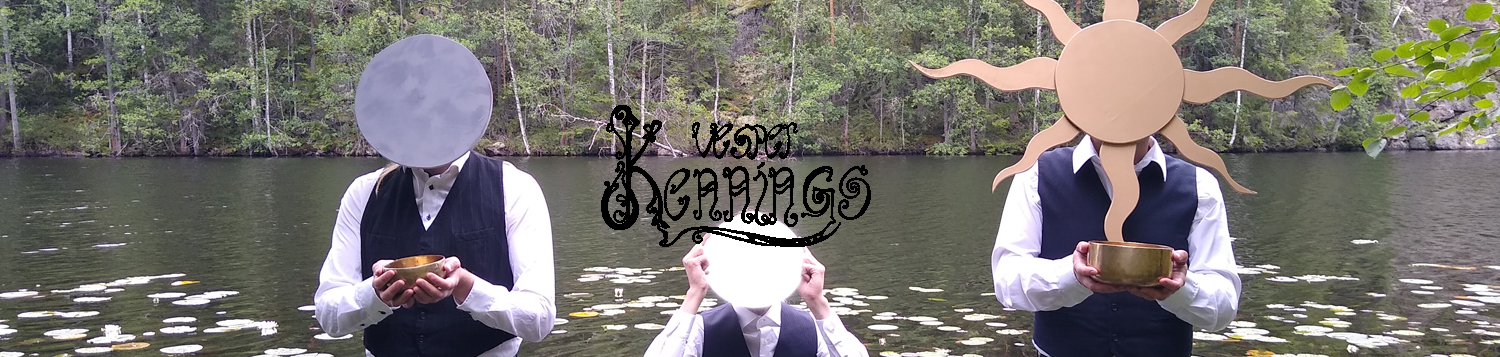
For those who’ve been following our site for a while, the name Vesper Kennings might ring a bell. This eccentric Finnish outfit released their first demo in 2019, and have since then released three albums (the so-called Terrestrial Vortices trilogy) and a couple of smaller releases. Digging into the complex, intertextually rich world of Vesper Kennings reveals rich layers of symbolism, references and correlations drawing from a multitude of sources ranging from the western literary canon to contemporary subculture to deep esoteric and mythological currents. Wanting to discover what lies behind all this, we reached out to the band. Vocalist S. Kalliomäki and guitarist O. Koskela – henceforth S.K. and O.K. respectively – graciously answered our questions, and dug deep into the mythical center of Vesper Kennings.
Let’s start with something rather obvious: the name. It combines two words from different languages: the Latin vesper, evening, and kenning, an archaic compound metaphor used in Anglo-Saxon and Scandinavian poetry. A classic example of the latter is “whale road” for sea, or, as S.K. illustrates, “bone-house” for human body. The name has an undeniable evocative power to it, but what does it actually mean – what are the kennings of vesper?
– I can distinctly remember learning about the concept of kennings in skaldic poetry, and besides being enamored with the concept, thinking that it would be a great name for a metal band, S.K. recounts. Later, when an as-yet-unnamed project of a rather different sound needed a name, he returned to the idea. But simply “The Kennings” wasn’t perhaps quite a fit for this new project – and besides, there had already been a short-lived band of that name.
– We then took the etymological route of looking at the origin of the word and backtracking to its root in the verb for knowing, kept alive in the phrase “beyond one’s ken”. So if you look at the word “kenning”, and instead of the ancient poetic trope think of “knowledge”, “understanding” or “perception” of something, then I guess vesper kennings appear as something only glimpsed at dusk. Twilight often represents a sort of liminal state between two realms, and with this symbolism in mind, the combination felt thematically fitting on more than one level, he continues.
A topic I’ve touched upon in my reviews is how difficult it is to pin Vesper Kennings to any genre. You can throw around genres like neofolk, folk and folk rock, but ultimately, none of them describe Vesper Kennings exhaustively. S.K. thinks along the same lines: folk does describe Vesper Kennings’ music at least insofar that a lot of the music is written first for acoustic guitar. There certainly are nods in the direction of neofolk, especially in its broader and less definite musical meanings, if not necessarily its conventional aesthetics. But there’s also a lot more, from layered synths and experimental soundscapes, psychedelia and even elements of both metal and classic rock, to muddle up definitions further.
O.K., for his part, relishes in being hard to define:
– It has been said of tribal shamans that whatever power they may possess within a community is due to their continual engagement with forces dwelling beyond that community. While there might be a bit of romanticization in that idea, I think there is beauty in the path chosen by witches, mystics and outcasts in denying their cultural status and relieving the burden of socialities. Especially in a time that is keen to label everything as or related to something, I find a certain solace in an idea of being at least somewhat difficult to define or associate with existing cultural spheres and related conceptual nominators.
With the same breath, he acknowledges that Vesper Kennings does not exist in a void. Instead, it exists and defines itself in interaction with its environment and cultural context. But perhaps the process is, at least to some extent, one of defining an outsider existence through this interaction, much like shamans and witches of old, who existed in the in-between space of “here” and “not-here.”
It is just as hard to place Vesper Kennings on a cultural or subcultural spectrum as it is to point their location on a genre map. Again, broad strokes are reasonably doable but are the equivalent of blowing one’s nose in a general direction, to paraphrase Monty Python. There’s not much of a “neofolk scene” in Finland, but even so, Vesper Kennings are not a snug fit for what little there is. S.K. muses that maybe they’re too modest and outsiders in spirits to talk of peers and colleagues, but still recognizes a certain common ground with artists such as those on Anima Arctica – who’ve they’ve shared a stage with on more than one occasion. A certain spiritual connection to metal also exists, in part due to all members’ long involvement in metal bands; S.K. feels that people from a metal context often intuitively grasp some of the band’s themes and aesthetics, without being alienated by the general weirdness. But, musically, it’s certainly not a snug fit.
In other words, Vesper Kennings, too, perpetually inhabit that space between “here” and “not-here”.
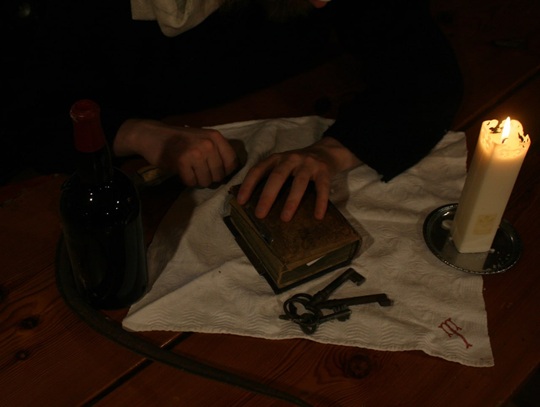
Apart from the demo and three albums, the band has released two smaller releases, Borrowed/Burrowed Bone and Poacher Songs For The Bonewhite Bailiff, which consist of borrowed or poached songs. This means songs with borrowed lyrics, or reinterpreted songs by other artists. However, one cannot draw too extensive conclusions from those two releases, S.K. muses. One significant influence is missing: metal. As mentioned above, all members of the band have a past – and some “a current” as well – in metal.
O.K. reflects that his formative years were spent within a black metal milieu, and he sees a certain mirroring of its spirit in Vesper Kennings and its take on the styles that have inspired their expression. Black metal at its core, as he sees it, is less of a genre or a scene than a striving among those deeply invested in it to embody what black metal is in their interpretation. Though sometimes the results are outright contradictory with each other, that fundamental passion is there, and the guitarist feels that there’s something of this sense of dedication that resonates in how he sees Vesper Kennings.
And yes, neofolk figures in as well. S.K. reminisces how the now defunct Kuolleen Musiikin Yhdistys group, who spread the good word of the post-industrial underground in Finland around the turn of the millennium through writing and concerts, had a formative impact on him and others in the group. And it goes even deeper and left field in this left field context: classic rock, progressive rock, contemporary classical music such as George Crumb and G.F. Haas, and so on.
It’s not only a varied but on a certain level shared musical background that has helped shape Vesper Kennings into what it is today. Most members have also known each other since childhood and, as S.K. puts it, they share a certain kind of psychogeography of growing in a rural small town environment. He points out that he doesn’t want to concoct some mythical pre-existence for Vesper Kennings, but muses that this shared life experience of growing up in this very environment is not without its role in the concept and essence of Vesper Kennings either.

Recently, Vesper Kennings’ music has been added to various streaming platforms. S.K. says they are great for reaching people and making music discoverable, but ultimately, one key element is missing: the packaging. As I’ve remarked in my reviews, the physical editions have become more elaborate with each album, coming with inserts and artifacts that complement and enhance the listening experience, as well as providing keys to the lyrical content of the music. Particularly on Eldritch Winter, these are quintessential:
– If you want to make sense of the lyrics as a whole, the inserts and especially the letters written in Finnish are essential to the degree that we later translated them into English and stashed them on our old-fashioned website among other miscellanea, the singer mentions.
Although a certain open-endedness is part of the idea with the inserts, S.K. denies that there would be much in the way of actual “red herrings” or deliberately misleading clues among the inserts. But, he admits, things aren’t necessarily always what they seem:
– Some things might seem like they point to some widely known mythology, when they’re actually derived from a piece of local folklore, or fragments of the “Christ-haunted heathenism” inherited from one’s grandparents or great-grandparents, he muses. S.K. explains what this “Christ-haunted heathenism” is: the backdrop of a worldview that was wholly Lutheran, in a sense, but also deeply invested in a belief in both protective and malevolent invisible forces, extra-sensory perception and the likes. A sort of liminal understanding of the world, between tradition and modern, secularized Christianity.
O.K. adds that bewilderment, mystery, uncertainty and sheer contradictions have a quality of truth that is not conceptual or logical but visceral in nature. “A carnal resonance”, as he puts it. And, he adds as a general observation, there are secrets without mysteries, attempts to hide the fact that there is nothing to be hidden. But in Vesper Kennings’ case, not so much of the latter.
– I think something we are constantly balancing with is how much to state explicitly, and how much to leave implicit or merely hint towards. In any case I would say that we are pretty honest in a sense, that we are not trying to intentionally mislead or be obscure for the sake of obscurity, but the matters we work with tend not to be something that would easily yield to a straightforward and unambiguous expression, he elaborates.
– To be obscure for the sake of aesthetic effect, which holds a truth of its own kind, is of course another matter, adds the guitarist. Perhaps with a slight wink.
Let’s delve into the lyrics, which are deeply entrenched in esoteric and mythological concepts. But is there some kind of tradition behind them? An important question, admits the singer. And not a straightforward one to answer, adds he.
– At the very least you could say that Vesper Kennings is bound to the question of tradition in a very comprehensive sense. Often to the question of its absence or disintegration and fragmentation. If you look at the world around you, a deep-seated human need or even longing for tradition appears ever more apparent with its dissolution, and I think many people otherwise entrenched in very diverse positions, often far removed from any type of conservatism, recognize it in some way, S.K. explains.
He adds, that in a way, without this rootedness to tradition, we are adrift in a sea of meaninglessness, which makes it difficult to approach the future with any sense of hopefulness, leading to a rather dystopian view of the future. The past has become a foreign land. And yet, we exist within tradition as the cultural context we are born into. Even if we are alienated from it, or even hostile towards it, it defines us, and entirely stepping outside of it is very hard.
– I think there is a sense in which one theme to our work is accepting the “handed down” nature of this heritage and trying to look at it with a new set of eyes, and uncovering new, living meaning in the familiar, the all too familiar even, that has become lifeless, mute and closed to us, muses the singer.
He acknowledges that whilst none in the band are “card carrying members” of any traditionalist school of thought, there are some thematic connections to traditionalist and perennialist philosophers. In particular, their concepts of the esoteric and exoteric aspects of tradition in the sense of finding an inner, hidden dimension to things normally known to us only through their outer forms. And the references certainly don’t end there.
If you look at the Terrestrial Vortex (the trilogy of albums Vesper Kennings has so far released -ed), the list of subtle and not-so-subtle nods on the trilogy extends from Norse and Finnish mythology to hermetic and gnostic symbolism, and from Biblical allusions to Crowley references. One way to read these is just as a reflection of being deeply immersed in that sort of syncretistic “occulture”, but I think here too, they are tied to a constant theme of searching for something that is almost lost, or at least scattered and fragmented, he delves into some of the many intertextual references to be found.
– Maybe one vein of interpretation could run along a general disillusionment with the contemporary pick-and-choose marketplace of spiritual ideas and practices. People turn to various directions in search of authentic spirituality when they feel traditional religion offers them nothing but moralism and sentimentalism, but the field of alternatives is rife with calculating grifters, narcissistic posers and sectarians more into identity games and politics than anything else, the singer adds.
S.K. mentions as a sort of case-in-point that an over-arching subtext Wandering Suns And Harvest Moons is that of an inner work of spiritual transformation left incomplete. The birds that the protagonist faces, perhaps aspects of his soul, all somehow accuse him of overlooking something essential. Something seems to be amiss. One way to look at the songs is of the protagonist reflecting on his journey with a lingering sense of incompleteness with only vague hope of reconciliation. Could this be seen as an allegory within an allegory of the half-hearted, often misled ways far too many today embark on the quintessential journeys of self-knowledge and self-understanding, where many never reach any kind of conclusion to the journey, muses yours truly.
O.K. adds that it would perhaps be more appropriate to view Vesper Kennings’ lyrics as palimpsestic than syncretistic. There are layers upon layers, some concealed and some only partially visible. The result is a “new story” partially dependent on its connection to previous stories.
– One could say this process resembles the genesis of religious or esoteric traditions.

If this makes it seem like the extramusical or thematic concept of Vesper Kennings is thought out, it’s no coincidence. S.K. insists this is the case, and that started evolving already before Vesper Kennings was a band proper. As he puts it, “in those late hours when many a band is founded only to be forgotten by daylight” – only this one survived the merciless gaze of dawn.
O.K. references the alchemical and hermetic tradition and think of Vesper Kennings’ framework as something rather holistic, an amalgam of musical and aesthetic ideas, religious and spiritual aspirations, philosophical and practical studies and so on. The ultimate goal of which is, in a way, to cultivate a sense of liminality – which, as probably has become obvious by now, is a frequently recurring theme for Vesper Kennings.
The band have on occasion described themselves as “mythopoetic music for twilit horizons”, which apart from sounding suitably esoteric contains the idea of mythopoesis as communion with our past and aforementioned tradition, but also myth-making as a means of bringing forth something new. As O.K. puts it, admitting he might risk sounding pompous, Vesper Kennings is a sort of condensation of a magical worldview at the feet of the end-times. So the twilit horizons assume both liminal and possibly even eschatonic meanings. An interregnum of sorts, S.K. muses, between an old world tired of itself, and one hidden beyond the horizon – invoking again rather traditionalist imagery.
– This is a time when the blade of scythe, beneath the layer of rust, is gleaming with ritualistic intent, the drunken brawls of idle men re-enact the ancient dramas of sanctification, and the rustic traditional tunes, as well as the cheesy schlagers and sentimental lounge-ballads, ring with an otherworldly echo of beauty and terror, of destruction and the possibility of salvation always entangled with it, O.K. waxes poetic, and continues:
– I think that what we need in current times are more exercises of thinking, working and being that steer away not only from self-centered but also human-centered ways, whether that means turning towards ineffable entities or non-personal traditions, or something called principles that exceed the wills and wants of an individual in an obliging manner, or to things that by themselves want, even need, to be expressed.
And to be sure, whilst not an underlined element in Vesper Kennings’ music, there is often a certain apocalyptic undercurrent to be sensed. Or perhaps more correctly the sense of being somewhere between an end and a beginning of uncertain nature, at the turning point of cycles – twilit horizons of a kind.
So far, all of Vesper Kennings’ releases have been self-released and distributed by the band themselves, making them something of a genuine hidden gem. Neither S.K. nor O.K. seem too concerned with this relative lack of “fame”, so-called. S.K. mentions they have a core audience, who always want to acquire whatever the band releases, but the band harbours no big dreams of great renown. O.K in fact seems to have a rather interesting take on this:
– Not too long ago we ventured into an abandoned house, where we found a bookshelf with several copies of an old book, apparently opinionated writings on political issues, which we told ourselves would have been written and self-published by the previous resident and met with rather limited interest by the reading public. We couldn’t help thinking how fine a monument, in all its melancholy and tragicomic quality, it would be if several years from now a random group of semi-delinquent youth broke into an abandoned house and found stacks of unsold record boxes by some long-forgotten band, poetically waxes the guitarist. And, certainly, there is a romantic appeal to this image: becoming a forgotten, confusingly surreal relic of a nearby past, almost like a reverberation from some stranger plane of existence.
O.K. muses, and admits to following the train of thought of other authors here, that what any artist strives for is some kind of self-annihilation through one’s work. To achieve joy through dissolution, through immolating whatever one has in terms of identity, and to become nothing. A worthy goal, adds he. S.K. also speaks of the emptying of self, although perhaps in a slightly more ascendant fashion: whether it manifests as a collapsing inwards, shrinking into nothing or expanding outwards, the goal and end result is the same. To overcome the miserable pettiness and smallness of man. I can’t myself help but think that perhaps artistic creativity is not only a drive to make external reality an inner voice and calling, but also a tragic exorcism. Tragic in the sense that once we’ve externalized the voice of that daimon, we’ve exorcised it for good, and are left all the emptier for it.

Let’s turn our gaze from inward and esoteric realm to a more temporal field. What about the future? Now that the Terrestrial Vortex has been explored if not exhausted, are there new cycles and arches to be explored?
– There are cycles within cycles, and our next full-length release in the works, Cinnabar Echoes, is supposed to become the first part of a series. But maybe it feels prudent to only discuss a larger whole, such as the Terrestrial Vortex, only after it has come into being. As for more immediate plans, we have two EP length releases, Kaikuja suuressa salissa and Lepinkäisenlehto, under preparation. They are more standalone, but in another sense, they will serve as forerunners of things to come, the singer reveals of future plans. And somewhat enigmatically adds, that the latter EP might turn out to be some kind of cross-artistic collaboration, but that it’s much too soon to speak much of that.
– We have a kind of map for forthcoming Kennings works. It is not, however, a very specific map and sometimes I feel like the terrain is changing also. I’ve elsewhere compared this to the kabbalistic tree of Life, or other comprehensive world-and-man-encompassing illustrations, by which one knows the tribulations to be faced but doesn’t really understand them until arriving upon and beginning the work. In any case, we’ll end up somewhere, O.K. adds.
Ah, but let’s leave the final word to Vesper Kennings before I start rambling on too much. S.K. succinctly sums up how the band see the future:
– I imagine we will continue doing what we do, like a tree that has taken root in an unlikely place will continue to grow and bloom, regardless of its prospects of proliferation, and feel grateful when our work does happen to reach people who can appreciate it on one level or another.
Visit Vesper Kennings on their official website, Bandcamp or Facebook
 Only Death Is Real