
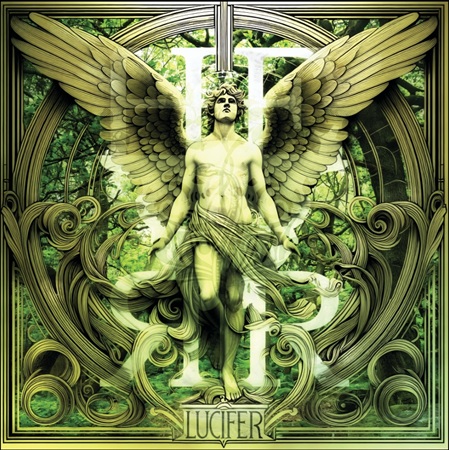
Year: 2025
Label: self-released (distribution via Steinklang Industries)
This album has been a long time in the making. multinational H.E.R.R.’s ambitious album Vondel’s Lucifer – First Movement was released way back in 2006. As implied by the name, it was not a complete work. Now, finally, almost 20 years later, the neoclassical project return to wrap up the heavenly, cataclysmic saga.
As the name implies, Vondel’s Lucifer is based on the classic tragedy of Joost van der Vondel, Lucifer. The work from 1654 is apparently considered one of the foremost works in Dutch literature, and a staple of western literary canon. I say apparently, because I must admit to not having familiarized myself with it, so I’m relying on Wikipedia here.
To summarize the plot very, very briefly and roughly, it is one most everyone should be familiar with: the classic story of the angelic rebellion led by Lucifer, and the resulting fall from Heaven. Apparently Vondel embellished his depiction of this classic story with many original concepts and details; the result was a widely controversial play, which was quickly banned from being performed.
But, on to H.E.R.R.’s contemporary interpretation of the work, and the topic of the day, the second part of it. I was about to write “modern” instead of contemporary, but that would have been plain wrong: there’s nothing inherently modern about Vondel’s Lucifer – Second Movement. Instead, like usually is the case with post-industrial neoclassical music, H.E.R.R. aim for the timeless and the eternal.
Indeed, there is a strong baroque element to Michiel Spapé’s music, and in particular to the carefully orchestrated, nuanced and intricate arrangements. If you allow a slight flight of fancy, closing my eyes I can imagine beautifully decorated halls and ballrooms of bygone ages, populated by the equally baroque aristocracy and nobility. Troy Southgate’s and Miklós Hoffer’s narration transform these into the Heavenly halls, wherein angels congregate to act out their conspiracies, allegiances and conflicts under the absent gaze of God.
The music beautifully captures and transmits the nobility, the defiance, the bombast and the tragedy of Lucifer’s heavenly revolt. Woodwind instruments reverberate with the forlorn tragedy of unity lost, of brother against brother; the strings echo with nobility and beauty, whilst the horns and percussion add layers of martial, belligerent defiance. The vocals, mostly recited, give shape to the evocative abstraction of the music.
Neoclassical is in itself a bit of a non-descriptor, considering everything that gets called by that name. However, I feel that in many ways, H.E.R.R. are at the very core of at least one definition of the term. There is obviously a heavy influence from classical composers and the tradition of European classical music, but Vondel’s Lucifer – Second Movement rises above any half-baked attempts at merely recreating the music of bygone eras. It takes the sonic shape of “high” European music and unites it with the post-industrial context from which at least most of the musicians involved come. The result is, as already alluded to above, contemporary but not modern… in a word: timeless.
Vondel’s Lucifer – Second Movement is a lot heftier than its 43 minute running time would suggest. It’s not something you take in with one sitting or casual listening. It demands a bit of effort and dedication on behalf of the listener, but it rewards such effort amply. It is a work of subtle beauty, of unadulterated spirit, of philosophy made music.
H.E.R.R. don’t seem to have an online presence; visit Steinklang’s webshop for more info
 Only Death Is Real