
Year: 2025
Label: In Illo Tempore/Gladivs Records
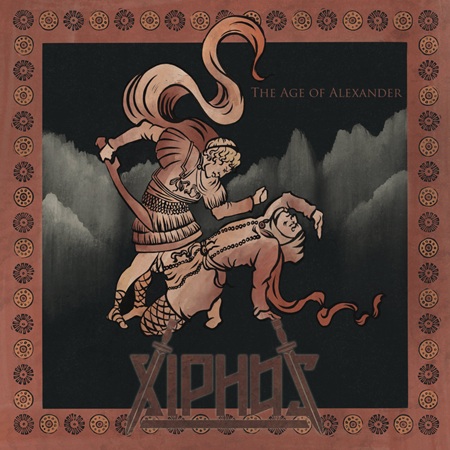
Taking their name from a short sword used by ancient Greeks, multinational Xiphos (not to be confused with the other Xiphos we’ve covered before) appropriately put their thematical focus on Ancient Greece. Though there have been significant shifts in the line up of the group since their debut album The Rise And Fall Of Athens (2022), the thematic approach remains largely the same: each track takes its name from some historical figure, and presents a biographical account of said person.
The significant line up change is that Matteo Brusa, who was responsible for all music on the debut album, has been replaced by Simon Shelmerdine (Dark Awake, Schatten Muse). As before, the vocals are handled by the duo Troy Southgate and Miklós Hoffer.
Xiphos’ expression is somewhat unusual within the realm of martial industrial/neoclassical in how it puts the vocals and lyrics into central focus. True, there are plenty of artists within the genre(s) who utilize a lot of vocals, but Xiphos still stand apart. Not only in the amount of vocals, but their nature.
As mentioned above, the lyrical matter of The Age Of Alexander is centered around historical persons of antiquity. With their half-sung, half-spoken vocals, Southgate and Hoffer paint dramatic poetical images of these persons and key moments of their lives. The lyrics are far from simplistic rhyming verses and tepid platitudes; instead, they are long, complicated and at times, quite prosaic. Rarely if ever have lyrics played such a pivotal part in music of this kind.
This means two things for Xiphos and The Age Of Alexander. One, this certainly isn’t easy listening music to be put on in the background. No, The Age Of Alexander requires full, uninterrupted attention. Second, the change of such a quintessential role as composer and arranger of the music probably won’t feel as drastic as it would with most other projects.
Which doesn’t mean we’re belittling Shelmerdine’s role on the album. Everything but. His compositions on The Age Of Alexander prove conclusively that he has understood the needs and demands of a project like this: the compositions often lean towards the understated, whilst the arrangements can be quite rich.
In other words, there isn’t much in terms of strong, attention grabbing melodies or ornamental details here. Nothing that would wrest the attention and focus away from the vocals and the lyrics. In that way, Xiphos sometimes even leans towards ambient territory. Very much in the same way a movie soundtrack might.
But, it would be entirely erroneous to speak of simplistic compositions. No, the compositions and arrangements powerfully accentuate the narration and atmosphere of the lyrics. From the martial majesty and mystery of Demetrius (a personal favourite) to the evocative mysticism of Phocion to the dramatic pomp of Pelopidas, the music aptly accentuates and fleshes out the lyrics. And it is particularly the arrangements that shine: by utilizing classical instruments, choirs and bombastic percussion (or synthesized counterparts), Shelmerdine adds immense depth and texture to The Age Of Alexander.
It’s quite easy to draw comparisons to some of the other projects the members are involved in. The shared vocal duties of Southgate and Hoffer inevitably lead one to think of H.E.R.R., where the two also handle the vocals jointly with a very similar dynamic. Musically, on the other hand, The Age Of Alexander certainly echoes the most martial, orchestral and neoclassical pieces of Dark Awake.
But ultimately, The Age Of Alexander is not just a mash-up of H.E.R.R. and Dark Awake. Underneath the superficial similarities, Xiphos is of a different nature. Less baroque in nature than H.E.R.R., musically The Age Of Alexander has more the bombast and drive of the soundtrack to an epic movie; something which Shelmerdine fully leans into, separating The Age Of Alexander from the dark post-industrial nature of Dark Awake.
The end result is a majestic and surprisingly complex album, which takes a bit of time to get to grips with. After first listen, The Age Of Alexander may well come across as flat or bland: the album demands further listening. Only after immersing oneself in its lyrical world does one start to understand how the lyrics and the music complement each other. And only then can one truly appreciate both the depth and the breadth of the album.
 Only Death Is Real