
The concept album is a notoriously risky thing. The prospect of telling a story over the arch of an entire album, tying together all tracks into a conceptual, thematic and/or narrative whole has proven to be a surprisingly tricky thing to do. More often that not, the end result is a conceited, puffed up, presumptuous jumble where the music suffers from what often turns out to be a second rate narrative.
The country concept album is a doubly risky thing. Country is, after all, a genre that has always been very much centered on individual songs. Traditionally, country music albums were a collection of songs centered around a few hits, padded with less stellar tracks. Testament to this is the relative scarcity of genuinely classic country albums in comparison to the sheer volume of country music albums in existence.
Perhaps the most ardent purveyor of the country music concept album has been outlaw icon Willie Nelson, who throughout his career has released several concept albums and even managed to cement at least one of them, 1975’s Red Headed Stranger, as a country classic.
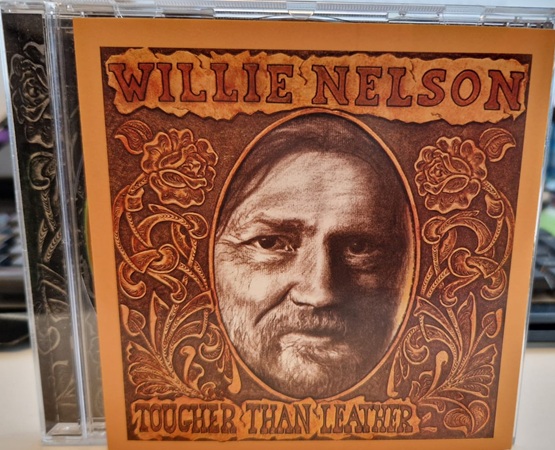
The liner notes to the 2003 re-release of 1983’s Tougher Than Leather – pictured in the header image – immediately draw comparisons between it and Red Headed Stranger. And true enough, the 1983 album has both musical and thematical parallels to Nelson’s classic concept album. Both narrate the tale of a man on the run from a lethal deed and a tragic love story, presented to a musical backing of sparse, understated instrumentation. But, in the end, Tougher Than Leather is a deeper concept album – perhaps to its detriment, at least as far as commercial viability was concerned.
Apparently, again referencing the liner notes, Nelson had had a brush with death before this album, suffering from a collapsed lung. Nelson, who’d long been interested in both oriental philosophy and spirituality, was (and probably is) a believer in reincarnation, which is the over arching concept of this album: it tells the story of an aged gunslinger – the namesake “tougher than leather” of the album – who kills a young challenger almost as an afterthought, leaving the latter’s young fiancee grieving. Our protagonist dies from “a poison inside”, only to fall in love with the same young woman in his next incarnation.
It’s certainly a story heavy on interpretations and levels. It is a mystical cowboy romance; a tale of karmic consequence and redemption; a parable of facing one’s past and making peace with it; a story of love that transcends mortal boundaries. This heavy conceptuality, combined with essentially no songs that stand out as obvious hits, means it’s no wonder Tougher Than Leather confounded more than charmed listeners, and has subsequently not risen to become one of Nelson’s classics. (It didn’t fare too badly on release: it reached a respectable #39 on the pop charts.)
Musically, this might not be “peak” Willie Nelson, but it’s an album much stronger that its reputation would have one believe. Often accused of being somewhat bland and mediocre, it does in fact contain several very strong tracks, especially its love songs. Album opener Changing Skies is a touching meditation on the transcendent nature of love, capable of surviving from cycle to cycle; Summer Of Roses is a delicate, tender song about the completeness of what the protagonist knows to be an all-too-brief romance; and the waltzing I Am The Forest, invoking the majestic powers of nature, rises to become a paean to the unconquerable, undefeatable strength of love.
Just like aforementioned Red Headed Stranger, Tougher Than Leather relies on relatively understated arrangements, leaning heavily on a predominantly acoustic soundscape. Typical to Nelson, the instrumentation is laid back and sort of languid, accentuated by Nelson’s solos with his trusty old guitar Trigger – he always seems to come in half a beat too late, entirely on purpose. To be sure, the tracks lack the instantly captivating melodic hooks of Nelson’s biggest classics, but the material on this album is of an even quality, and the tracks gel together without losing their own, individual character.
In essence, Tougher Than Leather is an album that might seem a tad drab at first listen, but it’s one of those albums you have to give a bit of time to. Immerse yourself in it. And pretty soon, its strengths will rise to the fore.
Tougher Than Leather was the first Willie Nelson album I ever bought, back when I was first getting into country music in the mid-noughties. Being only superficially familiar with Willie Nelson prior to that, I did not have many expectations. And to be perfectly candid, at first I didn’t necessarily feel that Tougher Than Leather met those. I didn’t much like the album initially.
In fact, it required delving deeper into the discography of Willie Nelson, and learning to better understand him as a musician, composer and lyricist to fully appreciate Tougher Than Leather. I had to put Tougher Than Leather aside and get to know the classic sides – On The Road Again, Always On My Mind, Blue Eyes Crying In The Rain etc. – in order to appreciate it. And then, when I circled back, I understood what a little gem this album is.
Nelson’s been an incredibly prodigious artist (Wikipedia lists 102 studio albums in 63 years) and it’s true that his discography is pretty uneven. The classics are balanced out by plenty of filler. Within that body of work, in my not-so-humble opinion, Tougher Than Leather stands out as a very strong and durable album – and indeed, an album, not a collection of songs. It is thematically complex and multifaceted, but not at the expense of the songs, resulting in an album that can both be enjoyed as music, and as a Buddhist cowboy fable ripe with possible interpretations.
In From The Vaults we take a dive into the record collection at Only Death Is Real HQ and write about about items of iconic stature or personal significance; rarities and oddities from the archives; obscure gems that deserve more attention; classics of yore deserving of a moment in the limelight; and so on.
 Only Death Is Real