
Year: 2024
Label: Zoharum/Esion Records
Here’s a misleading name if I ever heard one. There’s absolutely nothing violent, belligerent or aggressive in Polish That’s How I Fight’s music. With a name like that, I’d expected, I dunno, maybe some kind of punk? But what we get is ambient.
And that’s not the only confounding thing about Movement Three. Considering everything confusing, abstract and vague about this album, one can only presume every seeming paradox and contradiction on it is intentional.
According to the promo sheet, this three track vinyl release doesn’t really have a Side A and a Side B; instead, the listener is encouraged to decide for himself in what order to listen to the album. The tracks, simply titled 29, 28 and 27, are presented in different order depending on where you listen to the album. On the promotional CDr I have, they’re in descending order, which is also how they appear on Zoharum’s Bandcamp; on the band’s own Bandcamp site, they’re ordered 28, 27 and 29. On the vinyl, apparently 29 occupies one side and 28 & 27 the other.
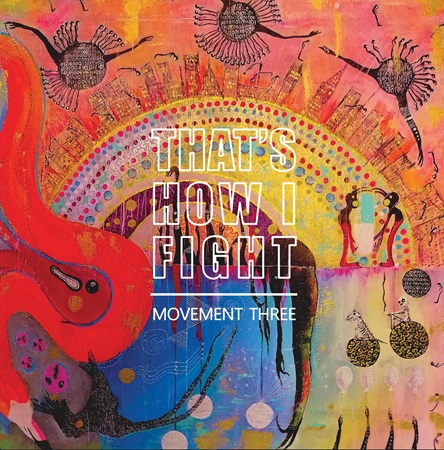
This conceptual abstraction extends to all facets of the album. The cover artwork, a beautifully, almost naivistically bright explosion of colours and shapes, gives no definite answers as to the themes of the album – but provides ample amounts to digest. Urban skylines, fantastical animals, meditative shapes, all presumably somehow relate to what Movement Three is about.
And because we’re talking about ambient, of course the abstraction extends to the music as well.
Psychedelic is the best word I can think of when I try to describe That’s How I Fight’s music. Movement Three feels like allowing oneself to be submerged into soft, undulating waves of cosmic ebbs and flows. Of sound changing into colour, form into sensation, shape into thought; of an incorporeal universe of intangible beauty and limitless benevolence. There is a decidedly trancelike, even shamanistic quality to the soft layers of That’s How I Fight’s sound washing on the shores of the listener’s consciousness.
Descending to a somewhat more tangible level, Movement Three’s ambience is built predominantly on soft, warm layers of slowly shifting, moving and throbbing waves of harmonious synthesizers. These soft layers of sound provide a canvas upon which instruments such as guitars and accordion paint slightly more defined musical shapes; not in the sense that these more conventional instruments would play actual melodies, but their character of tone can often quite easily be discerned. Especially the slow, droning guitar notes are an essential part of Movement Three’s sound.
Occasionally, percussion will punch through the waving layers of synths. Not in a dominating or rhytmical manner, though. No, the percussion feels more like ripples on the psychedelic fabric of That’s How I Fight’s sound, softly moving and perturbing but not disrupting the harmony of the musical ocean Movement Three explores.
In a way, Movement Three is extremely visual music for me, in a very synesthetic way. Through the medium of sound, That’s How I Fight paint fleeting, abstract images in the listener’s mind. What are those images? What kind of whole do they create? What does it mean?
That all is for the listener to interpret.
I’ve mused upon the pitfalls of abstract music before. Too much asbtraction risks resulting in flatness; providing nothing to the listener to fixate upon; no starting point from which to begin making interpretations from. That’s How I Fight avoid all of these: Movement Three is a beautiful, thoroughly evocative album in its abstract nature. It draws something from within the listener and makes it start taking shape. To dive into Movement Three’s soft ambience is a pure pleasure.
 Only Death Is Real
One thought on “THAT’S HOW I FIGHT: Movement Three”