
Release year: 2024
Label: Zoharum
The thing with abstract music is… well, that it’s abstract. I suppose this sounds like a redundant statement, but bear with me a moment. The thing with abstraction is that, essentially, it easily becomes shapeless and formless, which in turn risks falling apart into substancelessness. In terms of abstract music, this might mean that there’s absolutely nothing for the listener to deduce context or framework from.
Essentially, the music crosses over from abstract to pretentious, or even obtuse.
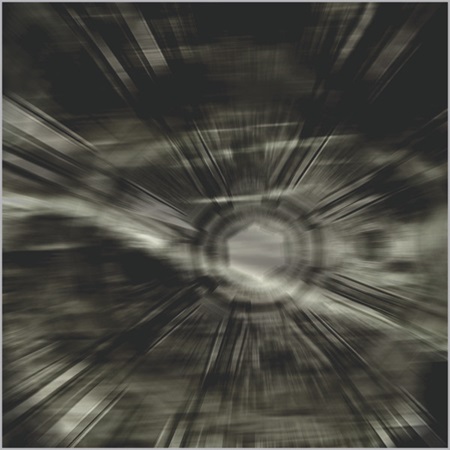
Listening to, and looking at Ulesa’s second album II, I cannot avoid these thoughts. The abstract cover is devoid of any concrete themes or symbols save for an empty hexagon within concentric circles; the tracks are named simply I-VIII, there are no liner notes; and as far as I know, Ulesa doesn’t mean anything.
And, as you probably deduced from above, the music is very abstract, too. In Ulesa’s case, this means slightly ritualistic and tribalistic, droning dark ambience. Long, drawn out, cosmic and ethereal waves of sound are accentuated by percussion which echoes as if coming from some distance. What sounds like violins and horns – possibly trumpet and at least one instance of saxophone – provide some anchors for the listener to concentrate upon. Needless to say, it’s not a question so much of melody as of texture. There are even some non-verbal vocals; on the penultimate track VIII there is what sounds like a man chanting something, but the words sound like no language I recognize.
As far as the mystic, obscurely ritualistic and distantly droning nature of Ulesa’s dark ambience goes, I am slightly reminded of Halo Manash, something off of their earlier recordings. The reverberating, echoing and spacious sound of Ulesa gives the music a sheen as of coming from some distance – either time, space or dimensional – which is not at all unlike the esoteric ritualism of aforementioned Finnish act.
But, unlike Halo Manash, Ulesa give no idea, concept or point to fixate upon. Though Halo Manash has always been highly veiled and esoteric in their symbolism, leaving a gulf of emptiness for the listener to interpret and decipher, there’s still always been something, at least an indication of concept.
It’s frankly a bit annoying that Ulesa keep things so obscure. Honestly, it reeks more of pretentiousness that obtuseness. Which, ultimately is the lesser of these two “evils.” I don’t think an album this competent and good could be born out of a shallow desire to create “ritualistic music” with no depth or substance to it. Thus, I am led to believe that Ulesa just want to keep their concept a secret, even when it risks crossing over into pretentiousness.
Because II is a good album, have no doubts about that. It’s mystical, it’s haunting, it’s evocative. Especially the beautiful, haunting female vocals lend each track they’re heard on a stark otherworldly atmosphere, as of reverberations from some other place of existence. The layers of echoing, droning, undulating ambience are as cosmic, ethereal waves, from which the more prominent elements (voices, aforementioned horns, etc.) rise like distant beings briefly taking shape before merging back into the tumultuous astral stream.
So, in the end: I moan and complain about Ulesa being sticklers for abstraction, but find myself second guessing myself. Maybe it doesn’t matter how abstract II is conceptually. One of the reasons for this is the album’s instant familiarity: if you’ve ever heard this kind of dark ambient before, you’ll instantly be able to place Ulesa and II into that context, and probably provide deeply personal interpretations to it based on what place music of this kind has occupied in your mind before.
Ulesa do not have a web presence; visit Zoharum’s website instead
 Only Death Is Real