
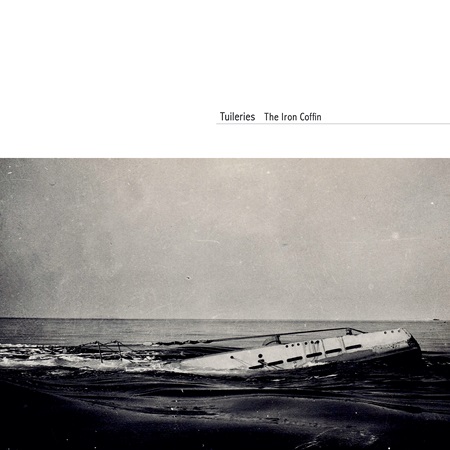
Release year: 2024
Label: self-released
The Second World War and submarines. My first association is, and always will be, the monumental cinematic epic Das Boot, one of the most gripping and intense movies ever made. Klaus Doldinger’s brilliant soundtrack has a significant role in making the movie what it is.
But it’s of course not the only depiction of submarine warfare during WWII. There are plenty of others, one of which is an autobiographical novel called Iron Coffins by Herbert A. Werner; apparently a classic in its own right (and one I admit to not having read). As the name of the album implies, it is Werner’s work Tuileries look to for inspiration on this album.
But I do think I hear faint echoes of Doldinger’s work here.
The Iron Coffin takes on a somewhat understated and even minimalistic style of neoclassical with a heavy focus on strings. This means soaring high strings and droning low strings, spiccato and staccato along with the occasional percussion to accentuate moments of action; passages of minimalist, drawn-out low-end drones that speak of the dark, absolute solitude and isolation under the waves, exploding into bursts of all-out dynamic action. It’s quite cinematic.
Take one of my favourite tracks from the album, Wasserbombe: the demanding and menacing staccato speaks of action, of a submarine cleaving the waves either on the hunt for prey or away after a sudden attack. Suddenly, it changes to a slow, lone, high string – a submarine hiding in the depths. Drones as of breaking, moaning metal – either a ship hit, or the structure of the submarine complaing under the pressure. At the best of times, The Iron Coffin truly paints scenes in the mind.
And here we come to Doldinger territory: some of the musical means Tuileries employ sound like open nods in that direction. This is not a dismissal or denunciation in any form. First of all, I think it’s almost inevitable and unavoidable to borrow some cues from the Das Boot soundtrack if one sets out to compose music about submarine warfare. And secondly, in doing so, Tuileries creatively utilizes familiar musical imagery to paint vivid scenes with the entirely non-vocal music.
As is only befitting, despite some uplifting moments of action and excitement, overall The Iron Coffin is dominated by somber, lonely and dark moods. The sparseness of the arrangements – often there are only a few instruments playing slow, persisting, drawn out notes – evoke the feelings of complete isolation, of being cut off from the world when out at sea or deep under the waves. And there is a definite oppressive edge to the music: the weight of the sea around, the constant threat of hunters, the knowledge that any mistake or failure can result in doom. Tuileries creates fine atmosphere on The Iron Coffin.
It could perhaps be argued that from time to time Tuileries overdoes the sparseness of the arrangements and compositions. Perhaps there could be a bit more dramatic flair in the instrumentation and variation in the compositions here and there. But considering how potently The Iron Coffin weaves its atmospheres and paints its pictures, its cinematic scenes, this is but the most minor of gripes.
And so, for fans of submarine warfare, of cinematic neoclassical and dramatic martial ambient, this is a safe recommendation.
Tuileries doesn’t seem to have an online presence.
 Only Death Is Real