
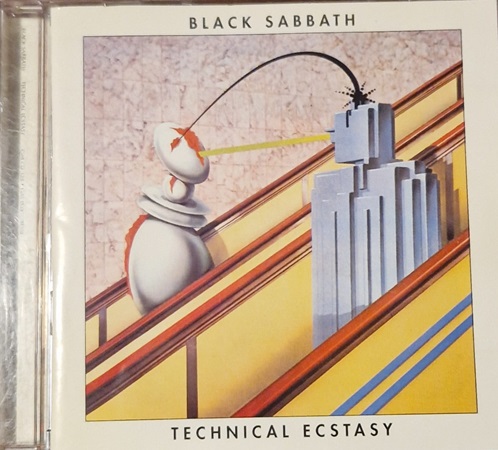
Black Sabbath’s Technical Ecstasy is a document of a band losing its way, lost in a maze of fame, success and above all: drugs. Already their previous album, 1975’s Sabotage started showing some serious cracks in the mirror, but on Technical Ecstasy, there was no more denying it. The founding fathers of heavy metal had, to a large extent, lost it.
I mean, look at the cover art. For the first time ever, Black Sabbath had an album cover dominated by bright colors and white. And the artwork itself… artsy, abstract, conceptual and oh so conceited. Vocalist Ozzy Osbourne said it depicts “two robots screwing on an escalator”, and there really isn’t any better description.
But, then, in terms of rock bands growing egos, vain artistic pretences and suffering from mammoth disease, there certainly are worse offenders out there than Black Sabbath and Technical Ecstasy.
The album kicks off with a pretty decent track: Back Street Kids isn’t an all-time Sabbath great, but it’s a solid track nonetheless. And it’s the only straight rocker on the album. Which is why it should have represented the album on the setlist of the reunion tour instead of the rather tepid Dirty Women and intensely annoying Rock ‘n’ Roll Doctor. Being forced to sit through these on a gig where the band didn’t play hits such as Sabbath Bloody Sabbath felt almost like a personal insult.
But already from second song on, it’s obvious that Sabbath have slipped even more than on Sabotage. Sabbath Bloody Sabbath – the album – showed the first serious signs of the band fumbling stylistically, but there the nascent identity crisis yielded their perhaps best album. Now, it just leads to a confusing, frustrating outcome.
Like It’s Alright. It’s the first Sabbath song ever to not feature lead vocals by Ozzy Osbourne: drummer Bill Ward steps up to the mic. I guess the Birmingham Four were channelling their love for The Beatles on this track? It really sorta sounds like a fourth rate Fab Four knock-off. And if that doesn’t confuse ya, there’s All Moving Parts (Stand Still), a stupendously monotonous track with the most annoyingly artsy fartsy Black Sabbath lyrics up ’til then. In terms of Black Sabbath and the level they’d kept up until then, these tracks really don’t cut it.
This was the last studio album by the original line-up I bought way back when in the mid-90’s, when I collected all of the band’s albums on CD. (Pictured in the top photo is the CD copy I own – mid-90’s Castle Communications re-release.) And it was a conscious choice: Black Sabbath was my favourite act, but I was fairly sure I would not like this album as much as the others. And I was right. This is definitely in my bottom rung of Black Sabbath albums, well below the oft-slammed Forbidden. I mean, at least that one was straight heavy metal.
As a kid, when I didn’t have much money, any CD I bought would be listened to incessantly. This was no exception. And I wanted to like it. It was, after all, an album by my favourite band in the world. I tried to listen to the album until I could convince myself I loved it. But, alas, that day did not come.
Listening to the album now, it’s as confusing as ever. There are moments when it sounds like Black Sabbath. Tony Iommi still cranks out some good riffs here and there. There are moments when I like the album. But then there are moments, where all I can hear a band who were lost in a maze of false ambition and haze of too many drugs. And sadly, there are more of the latter. Whilst my musical horizons have broadened immensely in the 30 years since I bought this album, Black Sabbath’s really shouldn’t have. They should have stuck to what they knew and did best.
I don’t hate the album. It has a weird thing going for it. I can’t exactly call it charm, but this odd sort of appeal, despite how messed up it is. Not enough to call it a good album, but enough not to slate it entirely.
I guess it’s those occasional moments when Black Sabbath sounds like Black Sabbath on the album. The idea that in another, drastically different universe, Technical Ecstasy could have been something else than a moment in time of the best band in the world falling apart fast.
In From The Vaults we take a dive into the record collection at Only Death Is Real HQ and write about about items of iconic stature or personal significance; rarities and oddities from the archives; obscure gems that deserve more attention; classics of yore deserving of a moment in the limelight; and so on.
 Only Death Is Real
One thought on “From the Vaults #5: Technical Ecstasy”