

Norja, Sara: ALKEMIAN HISTORIA
Release year: 2023
Publisher: SKS Kirjat
Available in: Finnish
Everyone knows about alchemy, right? It was that old superstitious belief that you could make gold from stone, or from other metals, and the ludicrous practice of trying to do just that. Just another example of how backwards and ignorant people used to be – but luckily something consigned to a darker, more ignorant past age.
Right?
Finnish philologist Sarja Norja clears her throat and says “Well, that’s not quite how it was…” At least that’s how I’d imagine she’d do when encountering the above opinions. Be that as it may, her first book Alkemian historia (A History of Alchemy) presents the history of alchemy from ancient Egypt to our days, and paints a very different picture from the stereotypical view.
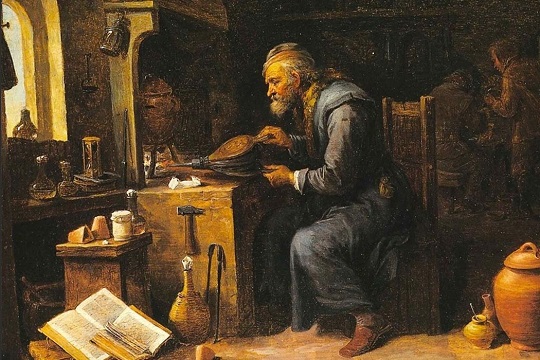
Alchemy can be divided into a number of subcategories, the two primary of which are probably material and esoteric alchemy. The former of these concentrates on the practical transformation of material to other things, the creation of the Philosopher’s Stone and the theoretical framework of these. The latter, on the other hand, is a more symbolic interpretation of alchemy, where the practical transmutation of a substance to some nobler substance is either perceived as a symbol for inner transformation or transcendence, or is seen as less important than spiritual transformation and ennoblement.
It is the former Norja’s book concentrates upon primarily. The choice makes sense: firstly, that is the form of alchemy that has been practiced more historically, and is also the one easier to make interesting to the layman. Esoteric alchemy with its complex and often paradoxical symbolism and, well, esoteric interpretations does not have the same kind of broad appeal to the general public. It gets very obscure very quickly.
And the general public, the layman, is the target audience of Alkemian historia. Norja writes with an easy-to-understand, straightforward style that seeks to explain key concepts and symbolism briefly but accurately, ensuring the reader knows enough of the symbolism and complexity of alchemy to follow the fascinating history of this old science and philosophy.

Norja presents a few key arguments, in which her intepretation of alchemy as a European, western phenomenom (she excludes other forms of alchemy; another sensible choice) differs from that of the general public. First of all, she argues that alchemy was not just pseudoscientific mumbo jumbo but a rather well-argumented and logical science within the context of its time. Secondly, she argues that alchemy was not just “primitive, misguided chemistry”, but that there is no clear demarcation line between “archaic” alchemy and modern chemistry. And, thirdly, she argues that alchemy is not a dead phenomenon of a bygone age, but something that remains to this day.
She argues for all these with well-formulated arguments, providing the reader with important historical context and placing the evolution, existence and practice of alchemy within this context. Prejudices of mystical bearded men engaged in pseudomagical ritualistic practice are soon dispelled: bearded and to some extent mystical these men might have been (the women involved in alchemy probably didn’t have beards), but for long times, alchemy was seen as a very much logical science that had little to do with magic; its methods and aims were not magical or supernatural, but rooted in the science of its age. Even people like Sir Isaac Newton believed in the possibility of transmutation, and engaged in alchemical research and experimentation.
The book convincingly illustrates how alchemy is responsible for some significant inventions and influenced society around it, and how the shift from alchemy to chemistry was not a revolution as such, but a gradual and often subtle shift in aim, method and philosophy behind it. Where alchemy as a science sought to affect change, chemistry sought to understand.
And, finally, the book plainly lays out the many ways in which alchemy still exists today – as a cultural phenomenon in entertainment and popular culture, as an esoteric symbolic doctrine… but also as an active striving for the Philosopher’s Stone and transfiguration sought by a small group of adepts.

In clear, well-flowing text of brief chapters and sections, Alkemian historia lays out the history of Western alchemy in an easily understood, but still informative and well-informed manner. The book presents in its 330 pages a large cast of real, mythical and possibly real people involved in alchemy, the numerous schools within alchemy, the theoretical framework and examples of alchemical practice. It is no mean feat to achieve all of this and still keep things from becoming heavy.
Still, I must admit that the passing and brief attention given to esoteric alchemy and its role in Western esotericism was a bit surprising. The book does mention H.P. Blavatsky and the Theosophical Society, but for example does not mention Éliphas Lévi and his The Doctrine and Ritual of High Magic at all – somewhat surprising, considering how replete it is with alchemical symbolism, and its quintessential role in all Western esotericism. I mean, Lévi’s Baphomet is one of the most recognizable esoteric images of all, and as the Hermetic Androgyne is replete with symbolism lifted from alchemy. The fact that Julius Evola’s The Hermetic Tradition does not get a mention is less surprising.
This oddity and the occasional minor fumble notwithstanding (the book mentions the pen-and-paper role-playing game Praedor, forgetting to mention it is based on graphic novels by Petri Hiltunen; as such Praedor would have better served as an example of alchemy in the latter field), Alkemian historia is a most entertaining yet educational introduction to the complex field of alchemy. Even in simplifying and making it accessible to the layman, Norja manages to keep that sense of wonder and discovery in alchemical symbolism: how reading a book like The Chymical Wedding of Christian Rosenkreuz is delightful thanks to the layers and layers of symbolism, allegory and metaphor. In fact, in explaining some of the fundamental symbolism, Alkemian history even functions as a sort of encouragement to dare read these evocative works.
And, great in her wisdom, Norja leaves many things unsaid. She uncovers and reveals much, but the quintessence of the Great Work and the preparation of the Philosopher’s Stone remain secrets. There are things not meant for all eyes.
Alkemian historia on SKS Kirjat’s webshop.
 Only Death Is Real