
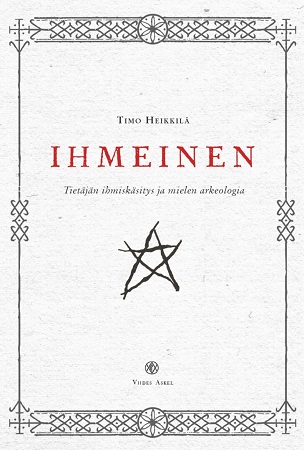
Heikkilä, Timo: IHMEINEN – Tietäjän ihmiskäsitys ja mielen arkeologia
Release year: 2022
Publisher: Viides Askel
Available in: Finnish
I think it was in Protector of the Sacred Flame, an essay anthology on the life and thought of Julius Evola, that one of the authors expressed the idea that when a Tradition has been broken, folklore and remnants of the mythology will provide constituents to recreate that Tradition. In essence, that by uncovering the true meaning of folklore hidden under the surface layer, elements of the lost Tradition can be found.
Unlike those of our western neighbours in Scandinavia, our folk beliefs were properly documented at a relatively late stage. Both the Prose Edda and the Poetic Edda were written down in the 13th century, whilst the collecting of traditional Finnish myth stories, poems and runo-songs didn’t happen until the 18th century, resulting in our national epic, the Kalevala.
Since our Finnish mythology and cosmology weren’t written down sooner, and Finnish culture didn’t become as developed and organized as Scandinavian/Viking culture did prior to christianization, much of the deeper, more esoteric aspects of it have been lost. Five centuries during which time the continuum of our traditional belief systems was finally and quite completely disrupted by christianization make all the difference.
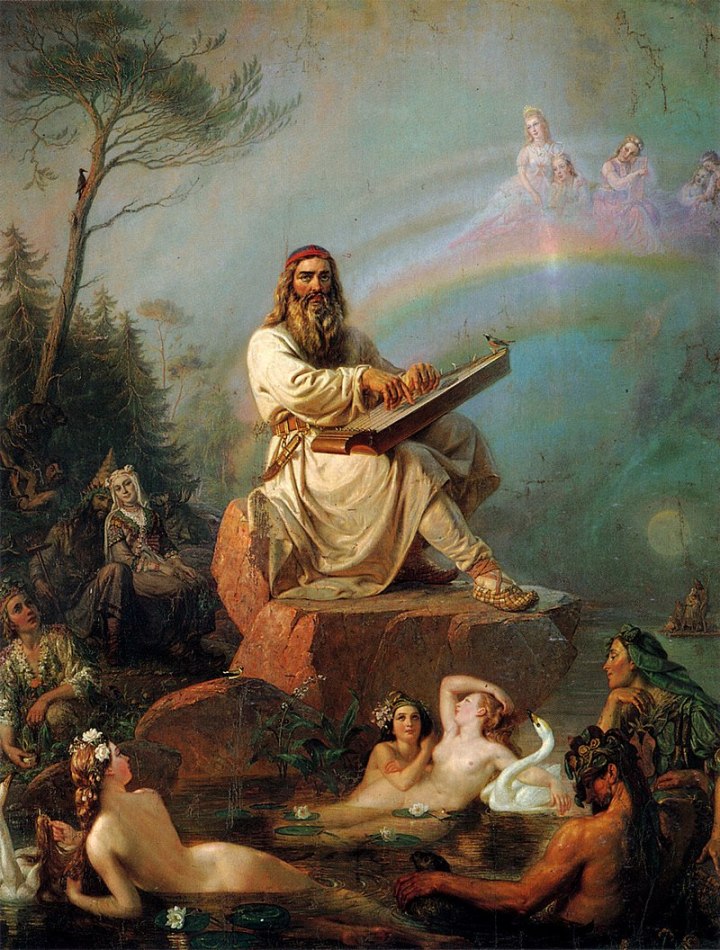
In a way, this is exactly what author and researcher Timo Heikkilä seeks to rectify with his book Ihmeinen – Tietäjän ihmiskäsitys ja mielen arkeologia. The main title of the book is next to impossible to translate, a portmaneau of “ihminen” and “ihme”, human and wonder. I guess “wonder-being” isn’t completely off the mark, but loses the beautiful nuances of the original. However, the subtitle translates to “the seers’ perception of man and archaeology of the mind”, which gives a very good idea of what the book is about.
By combining an exhausting amount of research from various fields, massive amounts of material and approaching the subject from multiple angles, Heikkilä seeks to uncover and reconstruct the cosmology and understanding of man of the ancient Finnish people. The book strives to present a coherent and systematic understanding of man, his role in the cosmos, and of man’s relation to various phenomena around him, as understood by the ancient Finns.
Some have described Heikkiläs’ approach to ancient mythology and history as “fictive research”, a more than somewhat derisive description implying the author combines scientific material with deeply subjective and/or imaginative interpretations. In the context of Ihmeinen, it is quite easy to say that this is the only possiblity: there is a definite limit to academic and scientific methodology, and beyond that point one must accept a more subjective approach – or stop there, and admit that our Finnish Tradition is irrevocably lost to us.

At the core of Ihmeinen is the Finnish human, and how the ancient Finn would interpret themself and the phenomena of the world around them. To paint this picture, Heikkilä draws from a massive body of material: copious amounts of old Finnish poetry and runosongs, ethnographical and archaeological research, traditional items and clothing, and so on. He combines these with large amounts of anthropological and historical research of other ancient cultures and their traditions, seeking to find plausible parallells where there are holes in what research can say about Finnish traditions and cosmology. To a large extent, Ihmeinen does not wax too poetical, but instead roots itself in existing research.
However, necessarily Ihmeinen frequently reaches the aforementioned limit, especially when extrapolating cosmological interpretations from myths and symbols. As such, there is much in the book that is conjecture, speculation and subjective conclusions. The book doesn’t try to hide the fact that at its core, it is a very esoteric work, dealing with things that are academical and scientific uncertainties and unknowables, and as such it frequently moves into territory outside of science. I see no need to pit these against each other, to dismiss either academic science or Ihmeinen’s more subjective and conjectural approach; rather, it’s essential to understand that Ihmeinen moves across this line frequently in seeking to present a possibility of the esoteric cosmology of the ancient Finn.
“Possibility” is a strong key word here. Given the nature of the book, a necessary subtext is that Heikkilä’s conclusions and concepts should not be held as absolute truths. He does argue for his hypotheses quite logically and reasonably, and very rarely indulges in ideas that seem too imaginative in the context, but the reader must still approach them with a healthy degree of questioning and criticism. In other words, the reader must understand that “archaeology of the mind” is not an exact science – or a science at all – which forces a lot of conjecture.
The 600+ page book is a hefty thing in all possible ways. It’s length alone makes it a daunting book to approach. It is also jam packed with such incredible amounts of information, concepts, ideas and topics that it’s essentially an impossible task to keep up with Heikkilä all of the time. He will constantly bring up new ideas, reference old ideas, present examples of runosongs or myth fragments, bring up comparisons to other cultures or present yet another analysis of some character or element recurring in Finnish myths. The text is a veritable deluge of names, terms, branching and intersecting topics. Luckily, Ihmeinen constantly cross-references itself, making it relatively easy to read up on what is written about the same thing elsewhere in the book.
The sheer weight of the book – both literal and figurative – makes it quite difficult to grasp the overall picture that Heikkilä paints of the mind and cosmology of archaic Finns, at least in any great detail. The book is so packed with these details that there’s a real problem of plenty – and a certain dryness of style doesn’t make things easier.
However, despite this slight dryness to the writing, Ihmeinen is a very evocative book. It frequently presents topics, ideas and concepts which will leave the reader ruminating. In a sense, the “archaeology of the mind” is not just trying to uncover how the archaic Finnish mind worked; it’s also about sparking fires in the reader’s mind, of unearthing ideas and knowledge the reader was unaware of. Of awakening an echo of our Finnish Tradition slumbering deep inside.

I have sort of double-edged opinions about the book. On one hand, in trying to be so comprehensive and all-encompassing, Ihmeinen risks becoming too much. The sheer volume of things thrown at the reader is daunting to say the least. On the other hand, in trying to present a coherent and systematic concept of an archaic Finnish worldview, nothing less than comprehensive would do. On one hand, Ihmeinen is a significant work – on the other hand… well, it’s still pretty damn exhausting to wrap one’s head around.
One can also question to what extent the book manages to penetrate the layers and veils of archaic myths and centuries that separate us from the ancient seers, runosingers and common people of the Finns. Does Heikkilä present an image that is true? Does he manage to weave together a unified worldview – and one that actually represents how Finnish people hundreds of years ago saw the world? There are no definite answers forthcoming; this is for the reader to decide.
But, all things considered, Ihmeinen feels like a work of true gravitas and significance. It sets out to present a well-argued and construed, detailed concept of an ancient, esoteric Finnish view on the world and man. And whilst the result is conjectural and a hypothesis, not something to be taken as an absolute, given fact, Heikkilä argues for his conceptions meticulously with an ample body of solid research. It passes into the realm of the esoteric, but it is not quickly slapped together, vague or presumptuous.
And, on many levels, what Ihmeinen presents has a ring of truth to it. It feels like Ihmeinen does uncover something vital of our archaic Tradition.
I don’t think there exists a work quite of this nature, at least on this level of comprehensiveness, in Finland. In this sense, too, Ihmeinen is a significant work.

Ihmeinen in Viides Askel’s webshop
 Only Death Is Real